Anniversary campaigns are often viewed through the lens of branding, storytelling, and employee engagement. But behind every successful milestone celebration is a complex operational effort involving planning, procurement, fulfillment, and distribution. As organizations prepare for major commemorative initiatives, from company anniversaries to large-scale national observances such as the upcoming America 250 celebration, the ability to execute behind the scenes can be just as important as the message itself.
Because even the strongest creative concept will fall flat if inventory doesn’t arrive on time, employees receive the wrong sizes, locations launch inconsistently, or kits ship incompletely. In a business environment shaped by e-commerce speed and personalized experiences, operational execution isn’t a backend function; it is the experience.
This post breaks down the operational layers most marketing, HR, and brand teams don’t plan for early enough, and what high-performing organizations do differently.
Why Operations Now Determine Anniversary Campaign Success
The bar for execution has never been higher. Consumer-grade delivery expectations have crossed over into employee-facing programs:
- 83% of companies now prioritize customer experience within supply chain strategy
- 73% of consumers say timely delivery matters more than price
- 81% of customers report satisfaction when delivery expectations are met
Those expectations don’t stop at customers. When anniversary campaigns involve employee recognition kits, event activations, or multi-location rollouts, the operational experience becomes the brand experience. A delayed kit or mismatched merchandise isn’t just a logistics failure — it’s a signal about how much the organization values the people it’s celebrating.
The Hidden Complexity Behind a “Simple” Anniversary Launch
On the surface, an anniversary campaign looks manageable: set a launch date, procure merchandise, activate events. Behind the scenes, it involves layered coordination across:
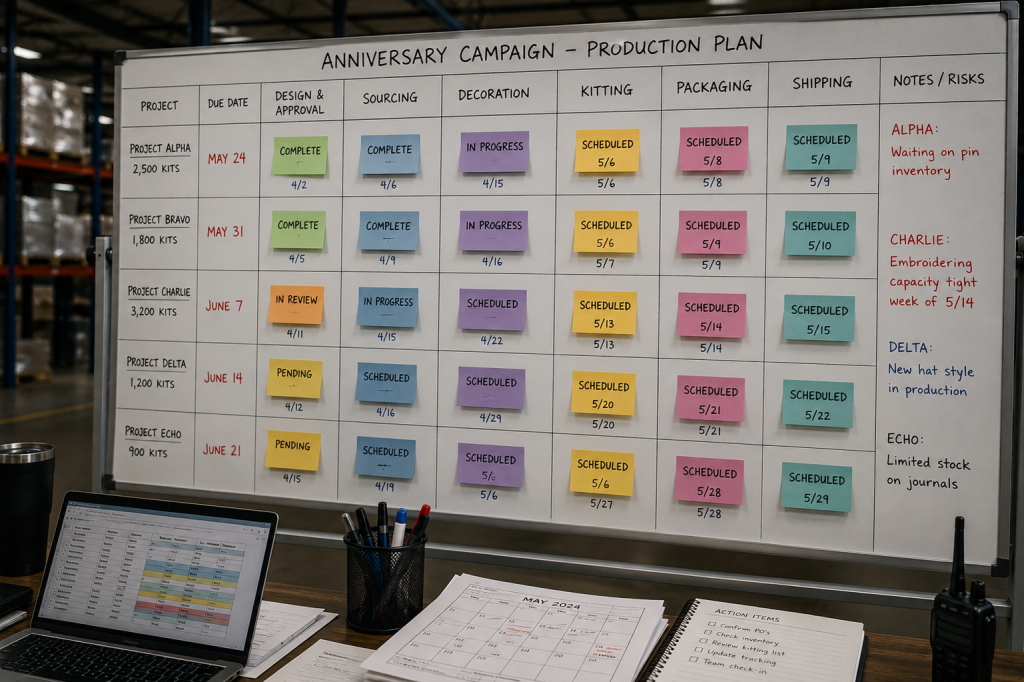
- Demand forecasting
- Vendor and production management
- Warehousing and inventory tracking
- Sizing data collection
- Webstore or ordering platform management
- Distribution across locations
- Kitting, packaging, and quality control
Each layer introduces risk. Most organizations underestimate how quickly those risks compound — especially under a fixed campaign deadline.
Inventory Forecasting: Where Most Campaigns First Go Wrong
Forecasting demand for anniversary merchandise presents a unique challenge. Unlike ongoing product lines, demand is event-driven, participation varies by location, and the margin for error is small.

The data reflects that difficulty:
- Average demand forecast accuracy across organizations sits at roughly 55%
- Forecast inaccuracies contribute to 20–50% operational inefficiency
- Inventory distortion costs businesses an estimated $1.6 trillion annually
For anniversary campaigns, poor forecasting translates directly into stockouts during peak engagement, excess inventory after the event ends, and budget overruns that are difficult to justify retroactively.
Strong campaigns start with data-informed forecasting models built around participation history, location headcount, and past campaign performance — not assumptions made in a planning meeting.
Multi-Location Distribution: The Real Test of Campaign Consistency
For organizations operating across multiple offices, regions, or retail locations, distribution becomes exponentially more complex. Staggered delivery timelines, regional demand variation, and uneven inventory allocation can quietly undermine a campaign that looks unified on paper.

The stakes are real: 70% of customers will switch brands after a stockout experience. The internal parallel holds just as true — inconsistent rollout breaks trust, uneven experiences reduce engagement, and campaign credibility erodes when some locations launch on time and others don’t.
Consistency isn’t just a brand principle. It’s an operational discipline that requires centralized coordination, real-time inventory visibility, and distribution planning that accounts for regional variation well before the launch window opens.
Webstores and Size Collection: Getting the Right Product to the Right Person
One of the most consistently overlooked challenges in anniversary campaign planning is also one of the most straightforward to solve: how do you collect sizing information at scale and ensure every employee receives merchandise that actually fits?

Two systems make this work:
1. Webstores for Order Collection A centralized webstore gives employees a controlled ordering experience, gives operations teams real-time demand visibility, and allows for managed inventory allocation before production is finalized. It eliminates the guesswork of bulk ordering and reduces the reorder cycles that delay timelines.
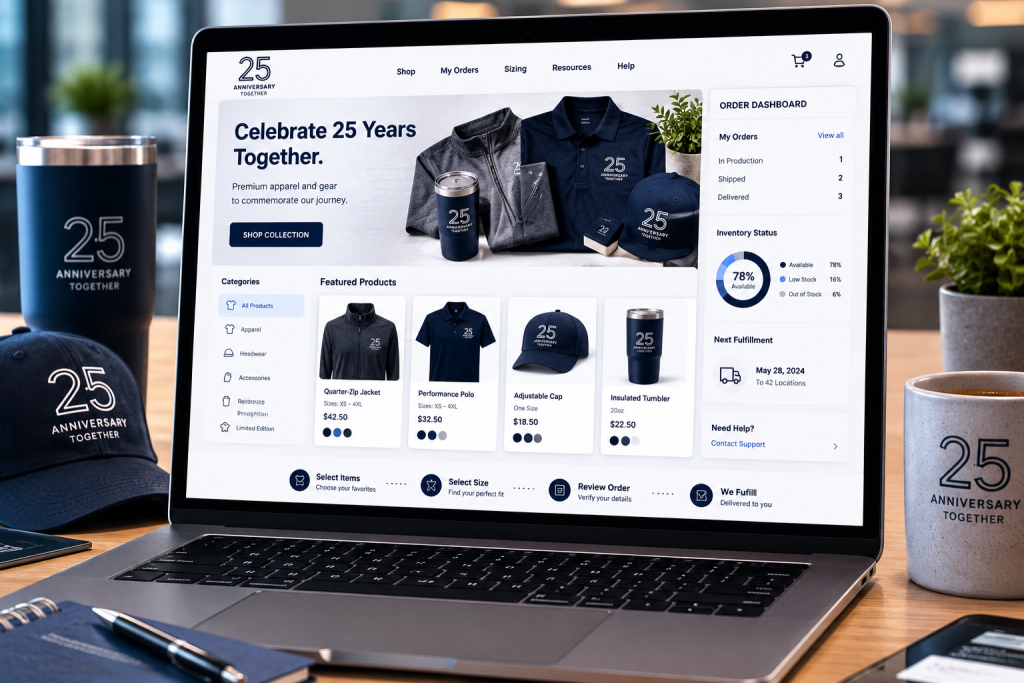
2. Structured Size Data Collection: Without a systematic approach to sizing, campaigns default to bulk distribution by assumed size distribution, which reliably produces overstock in the wrong sizes and shortfalls in others.
The experience impact is measurable. Only about 21% of employees globally feel engaged at work. Recognition campaigns that feel personal and intentional, including something as simple as receiving the right size, contribute meaningfully to that number. Campaigns that feel generic or poorly executed do the opposite.
Warehousing and Fulfillment: Where Scale Meets Precision
Once merchandise is produced, the operational challenge shifts to orchestration. Modern fulfillment expectations are calibrated against e-commerce benchmarks, with average order fulfillment times around 4.2 days, with 56% of consumers expecting same-day or two-day delivery on standard orders.
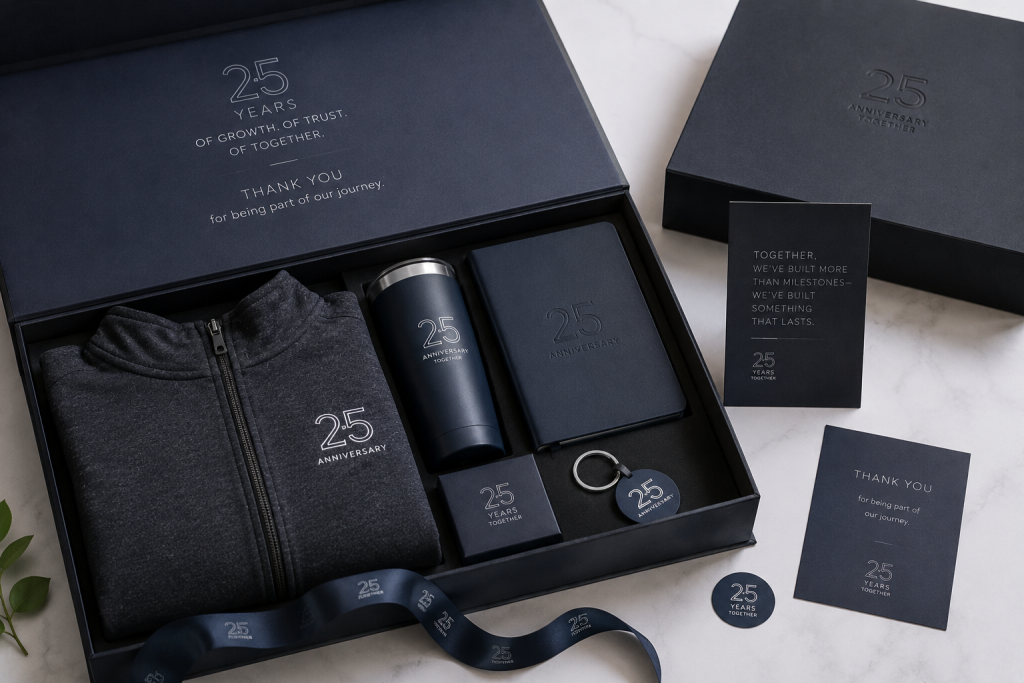
Anniversary campaigns introduce complexity that standard fulfillment doesn’t account for:
- Multi-SKU kits with several components
- Custom or co-branded packaging
- Sequenced rollout timing tied to event dates
- Geographic distribution across many locations simultaneously
Meeting those requirements requires centralized warehousing, accurate real-time inventory tracking, and structured pick-and-pack processes built specifically for campaign kits. Without operational rigor at this stage, fulfillment becomes the bottleneck, rather than the enabler.
Kitting: Where Strategy Becomes Tangible
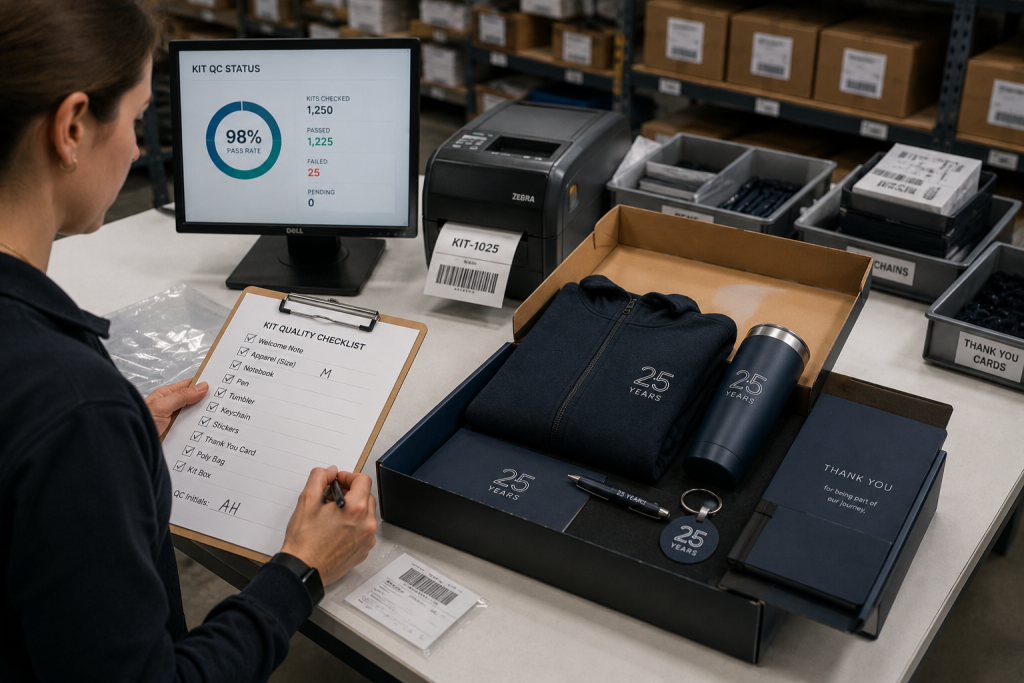
Kitting is the moment when months of planning become something a person holds in their hands. Each kit represents the brand, the campaign narrative, and the organization’s commitment to the person receiving it.
The complexity scales quickly with:
- Multiple product components across different vendors
- Customization by role, tenure, or location
- Sequential or tiered packaging for phased reveals
Successful kitting at scale requires pre-defined assembly processes, quality control checkpoints at each stage, and version control across kit variations. A small error rate that seems acceptable in testing compounds significantly when multiplied across hundreds or thousands of units.
Vendor Coordination and Production Timing: The Strategic Layer Most Teams Underestimate
Anniversary campaigns rarely draw from a single vendor. A typical campaign might involve apparel manufacturers, embroidery or patch decorators, custom packaging suppliers, print vendors, and logistics partners — each with their own lead times and dependencies.
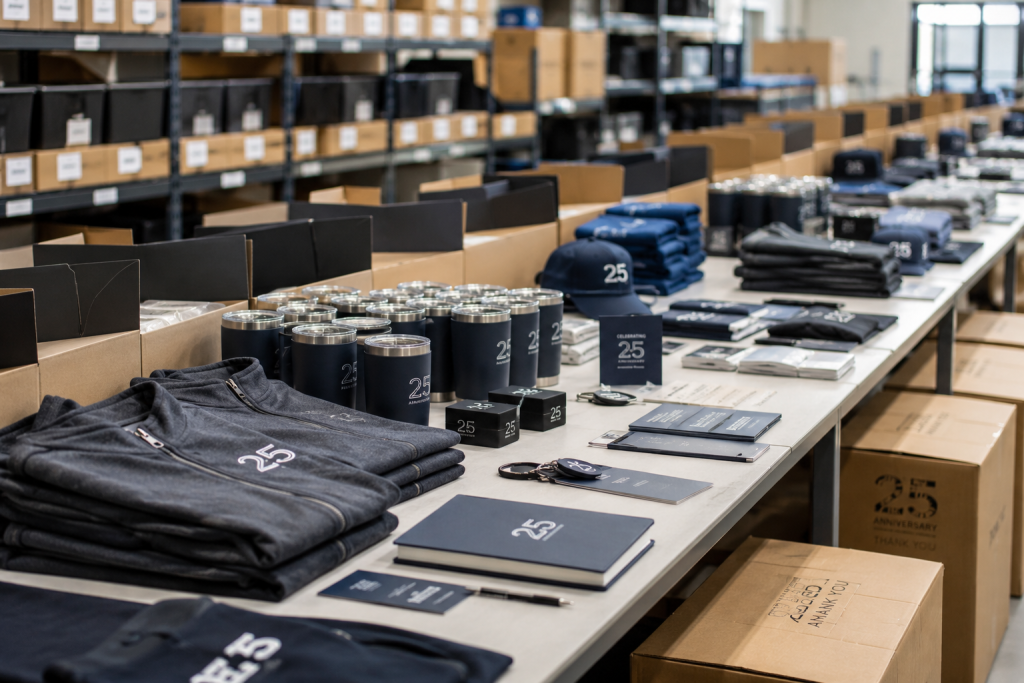
When those dependencies aren’t mapped carefully, production delays cascade. One late component holds up kit assembly. Assembly delays push fulfillment. Fulfillment delays compress the launch window.
The external environment compounds internal planning gaps. Global supply chain disruptions cost businesses approximately $184 billion annually, and lead times in many product categories remain 15–25% longer than pre-2020 norms.
Timeline planning for anniversary campaigns should be treated as a strategic function, not a scheduling task. Reverse-engineering from launch date through each vendor dependency — with buffer built in — is the difference between a campaign that launches on time and one that launches with apologies.
Phased Rollout Strategy: Extending Impact While Reducing Risk
The most effective anniversary campaigns aren’t single-day launches. They’re phased experiences designed to build anticipation, sustain engagement, and extend impact beyond a single event.
A structured rollout typically moves through three phases:
Phase 1 — Pre-Engagement: Teasers, internal communication, size collection, and demand confirmation. This phase reduces operational risk and builds anticipation simultaneously.
Phase 2 — Launch: Kit distribution, event activation, and campaign visibility at scale. With the operational groundwork laid, this phase can focus on experience rather than logistics recovery.
Phase 3 — Sustain: Follow-up recognition, content amplification, and program reinforcement. This is where the campaign investment compounds — or dissipates, if execution didn’t deliver.
Phased rollout reduces risk at each stage while giving organizations more touch points to make the campaign feel like a meaningful investment rather than a one-time gesture.
Event Coordination: Synchronizing Physical and Operational Execution
Live events add another operational dimension to anniversary campaigns. Location readiness, on-site inventory allocation, staffing coordination, and real-time contingency planning all require advance preparation that marketing timelines don’t always account for.

95% of consumers expect delivery or service issues to be resolved immediately. In event environments, that expectation means missing items need immediate resolution, on-site inventory needs flexibility to accommodate demand shifts, and backup planning needs to exist before it’s needed.
Events that look seamless from the outside are almost always the result of extensive operational planning happening well in advance.
Limited-Edition Inventory: Managing Exclusivity Without Creating Inefficiency
Anniversary campaigns frequently feature limited-edition merchandise, serialized items, or exclusive drops designed to increase perceived value and engagement. These elements work, but they also introduce inventory management complexity.
Controlled release sequencing, demand-driven replenishment where possible, and disciplined production quantities are essential. Without tight management, exclusivity quickly becomes inefficiency: overproduced “limited” items that lose their meaning, or underproduced items that create disappointment for those who don’t receive them.
What High-Performing Organizations Do Differently
Organizations that consistently execute anniversary campaigns successfully tend to share a few operational habits:
- They start 12–18 months in advance — not 6 months, and not after the creative concept is locked
- They integrate marketing, HR, and operations early — not sequentially
- They invest in forecasting and inventory strategy before committing to production quantities
- They use webstores for controlled distribution rather than bulk-ordering and hoping
- They standardize kitting and fulfillment processes with documented procedures, not improvised workflows
- They build phased deployment plans that sequence operational activities against campaign milestones
Most importantly, they operate with a shared understanding that operations isn’t support — it’s strategy.
Frequently Asked Questions About Anniversary Campaign Operations
How far in advance should organizations begin planning an anniversary campaign? Most organizations that execute milestone campaigns successfully begin operational planning 12 to 18 months before launch. This timeline allows for accurate demand forecasting, vendor lead time management, webstore setup, employee size collection, and phased rollout planning without compressing any single stage.
What is kitting in the context of an anniversary campaign? Kitting refers to the process of assembling multiple individual items — apparel, branded merchandise, packaging, inserts — into a single cohesive package for distribution to employees or customers. For anniversary campaigns, kitting is often where the brand experience becomes tangible, making process consistency and quality control essential.
Why do multi-location anniversary campaigns fail operationally? Multi-location campaigns most commonly fail due to inconsistent distribution timelines, poor inventory allocation across regions, and lack of centralized coordination. When some locations receive kits before launch and others receive them late — or not at all — the campaign’s credibility and engagement impact suffer significantly.
What is the role of a webstore in anniversary campaign planning? A webstore provides a centralized platform for employees to select sizes and preferences, gives operations teams real-time demand visibility before production is finalized, and enables controlled inventory allocation. It replaces bulk-ordering assumptions with actual data, reducing overstock and reorder cycles.
How does inventory forecasting affect anniversary campaign outcomes? Inaccurate forecasting directly causes stockouts during peak engagement, excess inventory after the campaign ends, and budget inefficiencies. Because anniversary merchandise demand is event-driven rather than continuous, standard forecasting models often underperform — making historical participation data and structured pre-order collection critical inputs.
The Bottom Line: Campaigns Are Remembered by How They’re Delivered
Anniversary campaigns are designed to create moments. But those moments don’t happen in design files or marketing presentations. They happen when an employee opens a kit that feels intentional, when a location launches on the same day as every other location, when a product arrives on time and in the right size.
Or they happen in the negative — when those things don’t occur.
In today’s environment, operational precision is what separates memorable campaigns from missed opportunities. Because at scale, execution isn’t just part of the experience.
It is the experience.