Walk through any airport security line the Friday after a major trade show and you’ll see the truth about trade show giveaways: branded tote bags abandoned at the TSA bin, stress balls left on armrests, stacks of glossy one-sheets stuffed into seat-back pockets. After all, if an item doesn’t survive the trip from booth to boarding gate, it never gets the chance to build brand recall at all, and at IDX, we built an entire evaluation framework around that exact moment of truth. We call it the Airport Test, and it’s the first of four filters we use to predict, before a single unit is ordered, whether event merchandise will create lasting impact or simply add weight to a recycling bin.
This isn’t a promotional-products trick. For instance, it’s applied event psychology; the same discipline IDX brings to booth experience design, attendee journey mapping, and event infrastructure planning. In fact, merchandise decisions made in isolation from the broader attendee experience are one of the most common (and most expensive) mistakes in event marketing.

The Real Cost of Disposable Swag
The data backs up what every event marketer has felt walking the trade show floor at teardown. Attendees who perceive an item as genuinely useful are roughly 52% more likely to stop at a booth in the first place, according to research cited by Custom Ink’s trade show marketing analysis. Once an item is in hand, retention separates winners from waste: PPAI-cited research found that 54% of consumers still have the last promotional product they received, meaning nearly half are discarded almost immediately. Meanwhile, ASI’s Global Ad Impressions research has found that certain product categories, like branded outerwear, generate thousands of brand impressions over their lifespan simply because people keep wearing them long after the show ends.

The gap between those numbers is the gap between merchandise that was selected for the booth and merchandise that was selected for the suitcase. Closing that gap is the entire purpose of the Airport Test framework.
IDX’s Four-Test Framework for Merchandise Retention
Before approving any item for a client program, we run it through four sequential filters. An item doesn’t need to score perfectly on all four, but the strongest performers in any IDX program pass at least three.
| Test | The Question It Answers | What It Eliminates |
| Airport Test | Will the attendee actually carry this through security and onto the plane? | Oversized, fragile, or low-value bulk items |
| Desk Test | Will it still have a place on their desk three weeks later? | Novelty items with no ongoing function |
| Utility Test | Does it solve a real, recurring problem in their workday? | “Nice to have” items with no daily use case |
| Brand Test | Does the branding feel earned, or just slapped on? | Logo-first design that ignores item quality |
The Airport Test
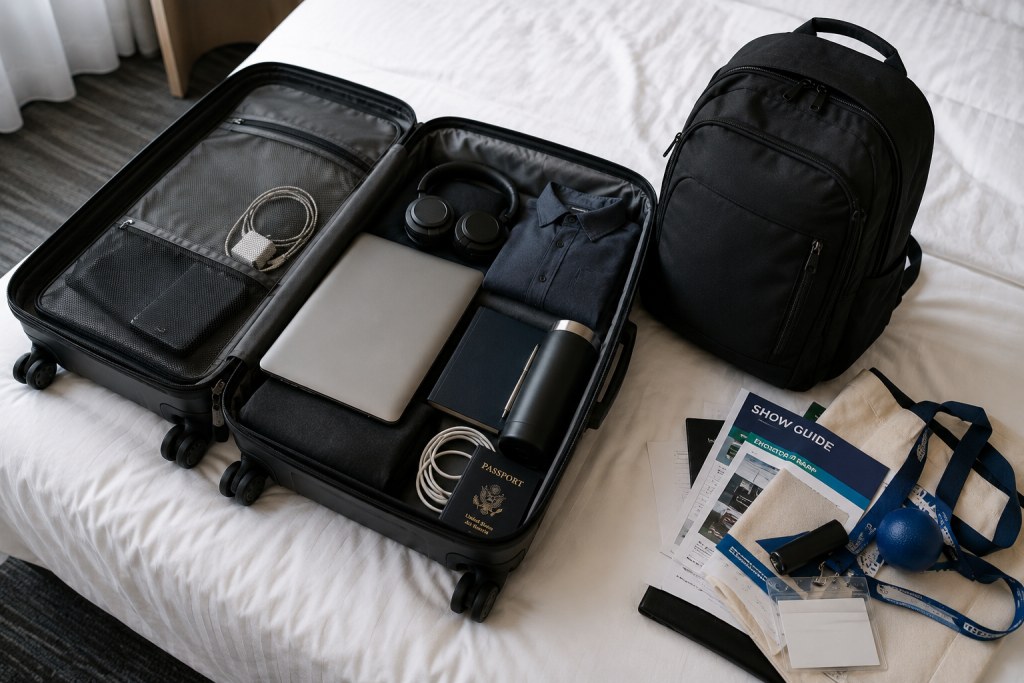
This is the literal, physical filter: weight, size, and durability. Attendees are flying home, often with carry-on restrictions and a stack of business cards already in their bag. Bulky, breakable items, or anything requiring checked luggage, get left behind; sometimes deliberately abandoned in the hotel room. The Airport Test forces a simple design constraint: would a busy attendee choose to carry this through a crowded terminal, or quietly leave it behind?
The Desk Test
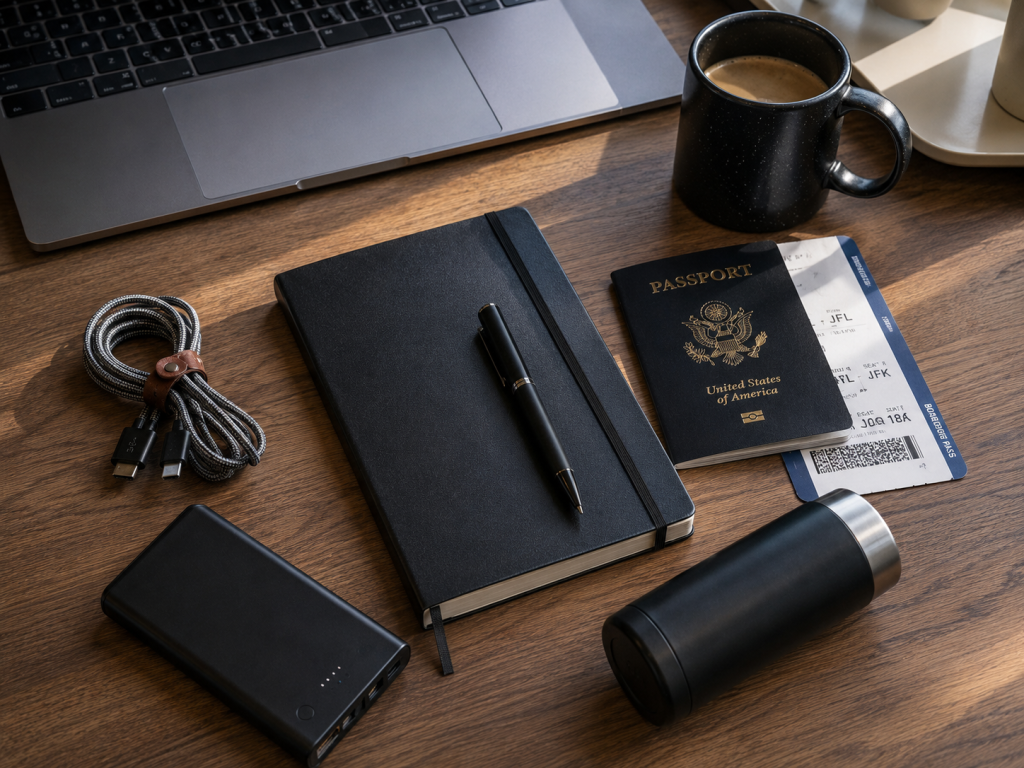
Items that survive the trip home face a second filter almost immediately: does it earn permanent real estate on a desk, in a bag, or on a keychain? Desk Test winners tend to share a pattern: they’re visible, used daily, and don’t compete with an item the attendee already owns and prefers. A premium notebook competes with the one already in someone’s bag; a genuinely better charging cable usually doesn’t.
The Utility Test
Utility is different from novelty. A fidget toy is novel for a day; a portable battery pack is useful for a year. The Utility Test asks whether the item solves a problem the recipient already has: slow phone charging, tangled cables, inconsistent hydration during travel, rather than introducing a problem they didn’t know they had (where to store yet another branded tote bag).
The Brand Test
The final filter is the one most teams skip. Branding should feel like a natural signature on a quality item, not the entire reason the item exists. When the logo is the most prominent design feature, attendees absorb one message: this is an ad. That short-circuits the trust that drives genuine brand recall. When the branding is a subtle, well-placed mark on something the recipient was already going to value, the message becomes “this brand has good taste”, a far more durable impression.

Quick-Reference Checklist: Selecting Merchandise That Passes the Four Tests
- Item fits in a standard carry-on or jacket pocket without bulk
- Item is durable enough to survive 2+ flights and a hotel stay
- Item has a believable, specific use case beyond “looks nice”
- Item solves a problem the attendee already has, not a hypothetical one
- Branding is placed thoughtfully, not dominating the entire surface
- Item doesn’t directly compete with a higher-quality item the attendee already owns
- Item ties back to the booth experience or campaign theme, not generic stock
- Plan fulfillment and on-site logistics so the right SKU reaches the right attendee segment
Why This Is an Infrastructure Problem, Not Just a Products Problem
Here’s the part most promotional products vendors miss: the Four Tests only work if merchandise decisions are made alongside booth design, attendee flow, and post-event follow-up; not bolted on at the end of a budget cycle. IDX treats merchandise selection as one component of total event infrastructure, integrated with the same planning discipline applied to booth layout, staffing, and lead capture. That’s the distinction between a vendor who fulfills a swag order and a partner who designs the full attendee experience, including the moment an item gets tucked into a carry-on instead of left at the hotel.

If your team is rethinking your next show’s merchandise strategy, it’s worth reviewing it alongside your promotional products and conference swag planning and inventory management and fulfillment strategy. The Four Tests work best as part of a connected attendee journey, not a standalone line item.
Frequently Asked Questions
What trade show giveaways do people actually keep? People tend to keep items that are durable enough to travel home easily, solve a real daily problem, and don’t compete with a higher-quality item they already own; things like quality charging cables, insulated drinkware, or well-made apparel, rather than novelty items or bulky printed materials.
What promotional products have the best retention? Apparel and outerwear consistently rank among the highest-retention promotional categories, with research showing many consumers keep and use branded outerwear for two or more years, generating repeated brand impressions long after the event ends.
Why do most trade show giveaways end up in the trash? Most giveaways are discarded because they fail a basic physical or practical test: they’re too bulky to carry home, too generic to use, or branded so heavily that they read as an advertisement rather than a useful item.
What makes a good trade show giveaway? A good giveaway passes IDX’s Four Tests: it’s easy to physically transport, earns a permanent spot in daily use, solves a real problem, and carries the brand subtly rather than dominating the design.
How do you measure ROI on trade show merchandise? ROI should be measured beyond initial cost-per-unit, factoring in retention rate, repeat brand impressions over the item’s lifespan, and downstream effects like increased booth traffic or lead engagement tied to the item’s perceived usefulness.
Does branded merchandise actually increase brand recall? Yes, studies consistently show a majority of recipients remember the brand associated with a promotional item they received, particularly when the item is used repeatedly over time rather than discarded shortly after the event.

Final Thought
The Airport Test isn’t really about airports. It’s a forcing function that exposes whether merchandise was designed around the attendee’s actual life or around a procurement spreadsheet. Brands that consistently pass all four tests aren’t getting lucky with product selection; they’re treating merchandise as one connected piece of a deliberately designed event experience, which is exactly the lens IDX brings to every program we build.