The Conversation Most HR and Marketing Leaders Dread
You know your merchandise program matters.
That shows up in onboarding feedback, and managers say it too. Employees wear branded apparel outside of work, and intuitively, you understand what that means for culture and retention.
Still, finance wants a number.
Here’s the real challenge: employee merchandise programs do have strong ROI. However, that ROI spans multiple domains: retention, engagement, brand visibility, operational efficiency. As a result, none of it shows up cleanly in a single line item.
Consequently, when the value is diffuse and the cost is visible, finance defaults to skepticism.
The fix: a framework that translates program value into financial language. Not approximate, nor anecdotal. Instead structured, measurable, and defensible.
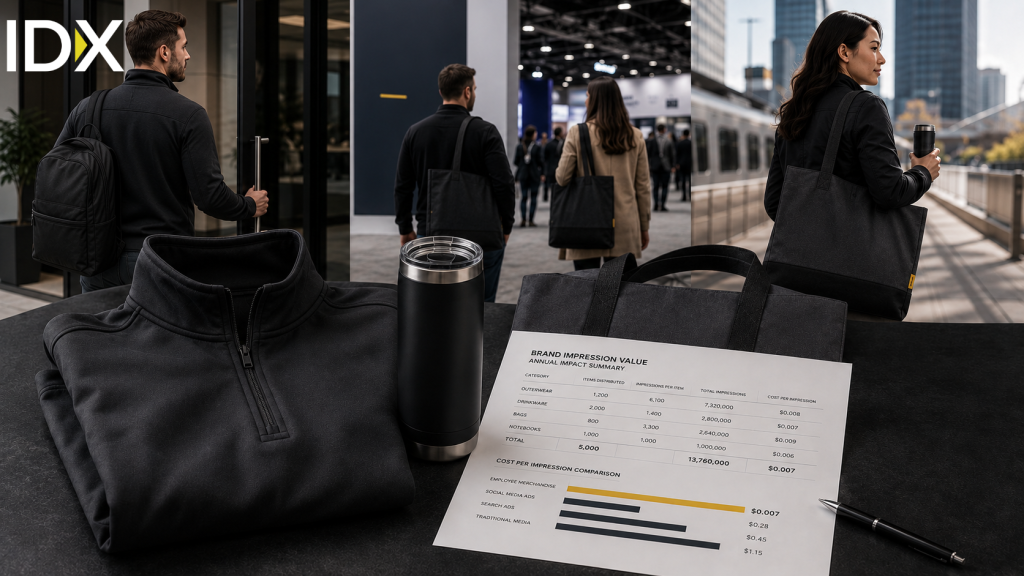
Why the ROI Is Larger Than Most Organizations Account For
Before building your business case, it helps to see the full scope of value a merchandise program generates. In fact, most organizations undercount it significantly.
Retention impact
- To start, replacing an employee costs 50–200% of their annual salary, per the Society for Human Resource Management (SHRM): recruiting, onboarding, productivity ramp, lost institutional knowledge, all included.
- In addition, strong onboarding experiences improve new-hire retention by 82%, according to the Brandon Hall Group.
- Therefore, if your merchandise program is part of that onboarding experience, it shares in that outcome.
Engagement impact
- Meanwhile, Gallup finds highly engaged business units achieve 23% higher profitability and 18% higher productivity than disengaged ones.
- Similarly, employees who feel recognized are 27% more likely to report high engagement.
- So, recognition merchandise is a direct input to that outcome.
Brand visibility
- Beyond that, the Advertising Specialty Institute (ASI) reports branded outerwear generates an average of 6,100 impressions over its lifetime.
- For a $60 item, that’s under one cent per impression, a figure that, notably, outperforms most paid media channels.
Recruiting signal
- Additionally, in competitive talent markets, offer-acceptance rates are shaped by perceptions formed during interviewing and onboarding.
- Thus, a polished merchandise program is a visible quality signal during exactly that window.
Building the Financial Model: Four Inputs
A defensible ROI model needs four inputs. None of them are speculative.

Input 1: Program Cost
This is the denominator of your ROI calculation, and it has four parts:
- Product and inventory costs (cost of goods)
- Fulfillment costs (warehousing, kitting, shipping)
- Platform/technology costs (employee store, order management)
- Administrative overhead (staff time managing the program)
Generally, most organizations undercount this by excluding fulfillment and admin costs, so include everything.

Input 2: Retention Value
- Start with your organization’s average annual salary for the population the program serves.
- Apply SHRM’s 50–200% replacement-cost range. A conservative 50% is defensible as a floor.
- Estimate the incremental retention improvement from your onboarding and recognition programs.
For example: a 1–2% improvement in first-year retention across a 500-person cohort at $65,000 average salary generates $325,000–$650,000 in avoided replacement cost.
That said, you don’t need to claim the full retention lift for merchandise alone, it’s one contributor among several. Instead, a conservative attribution of 10–15% of that impact is defensible, and the numbers still hold.

Input 3: Engagement Value
- First, use Gallup’s engagement-to-profitability link as your framework.
- From there, if you have a revenue or output figure per employee, a measurable shift in engagement translates directly into business impact.
- Otherwise, if you lack a revenue-per-employee figure, use productivity instead. Gallup’s 18% productivity gain for highly engaged employees still yields a calculable output, even with partial attribution.
Input 4: Brand Impression Value
- Calculate branded items distributed annually.
- Apply ASI’s impression-per-item benchmarks: outerwear (6,100), bags (3,300), drinkware (1,400).
- Divide total cost of goods by total impressions generated.
- Compare that cost-per-impression to your blended cost per impression across other marketing channels.
Ultimately, in most cases, merchandise compares favorably, often dramatically so.
Structuring the Presentation to Finance

How you present the case matters as much as what’s in it. Finance teams respond to specificity and intellectual honesty.
- Lead with cost structure, not vision. First, show you’ve accounted for the full cost before making any ROI claim, since full cost transparency earns credibility before the ROI argument even starts.
- Use conservative assumptions, and say so. Don’t inflate the ROI. Instead, a conservative model that survives scrutiny beats an optimistic one that invites challenge.
- Separate certain from attributable. Some ROI is direct and measurable (brand impressions), while some is attributable but assumption-based (retention, engagement), and some is real but unquantifiable (candidate perception, culture). Either way, label each category honestly.
- Anchor to a comparison. After all, finance thinks in comparisons: cost per hire, cost per engagement survey cycle, blended cost per impression in paid media. Framed this way, merchandise often wins.
- Present a plan, not a request. A plan includes prior-year actuals, performance metrics, and a forecast — what you spent, what it produced, and what you’re planning next and why. Ultimately, plans get funded, while requests get cut.
The Metrics to Track Before Your Next Budget Conversation
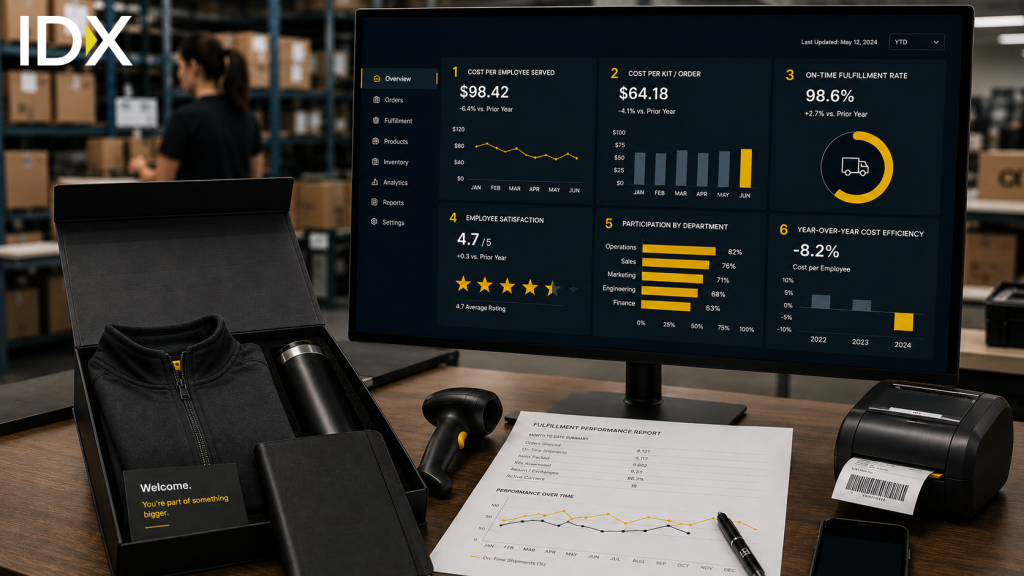
If you’re not tracking these yet, start now:
- Cost per employee served (total program cost ÷ active participants)
- Cost per kit or order
- On-time fulfillment rate
- Employee satisfaction with kit/store (post-receipt survey)
- Participation rate by department and location
- Year-over-year cost efficiency trend
Together, these metrics tell the story of a managed, improving program; one run on discipline, not a discretionary spend that fluctuates with whoever approved it last.
The Credibility Compounding Effect

Organizations that build merchandise programs with financial discipline do something their competitors rarely do: they compound credibility with finance over time.
Specifically, a program that shows up to every budget cycle with actuals, metrics, and a grounded forecast earns trust. Over time, that trust becomes budget stability, organizational investment, and room to expand when the opportunity arises.
Programs that can’t show their work get cut first.
Frequently Asked Questions
What is the ROI of an employee merchandise program?
It spans four measurable areas: reduced turnover (50–200% of annual salary per replacement, per SHRM), increased engagement (23% higher profitability per Gallup), brand impressions (6,100 per outerwear item, under one cent each), and recruiting signal value. Overall, most organizations undercount ROI by focusing only on product cost.
How do you calculate the cost of an employee merchandise program?
Four components make up the total: product/inventory costs, fulfillment costs (warehousing, kitting, shipping), platform/technology costs, and administrative overhead. Typically, excluding fulfillment and admin time is the most common way organizations underestimate true cost.
How do you justify employee swag or branded merchandise to finance?
Start by leading with full cost transparency, then use conservative assumptions, and anchor spend against something finance already funds: cost per hire, cost per engagement survey, or blended cost per impression. From there, separate direct ROI (impressions), attributable ROI (retention, engagement), and qualitative value (recruiting signal, culture).
What metrics should HR track to measure a merchandise program’s effectiveness?
Specifically: cost per employee served, cost per kit, on-time fulfillment rate, employee satisfaction (post-receipt survey), participation rate by department/location, and year-over-year cost efficiency trend.
How does employee merchandise affect retention?
Mainly through onboarding and ongoing recognition. For instance, the Brandon Hall Group finds strong onboarding improves new-hire retention by 82%. Even so, a conservative 10–15% attribution of that improvement to merchandise still produces significant avoided replacement cost, often hundreds of thousands of dollars annually for mid-size organizations.
How does branded merchandise compare to other channels for cost per impression?
On average, outerwear generates 6,100 impressions per item, under one cent each at a $60 cost. Similarly, bags generate roughly 3,300 impressions, and drinkware generates roughly 1,400. As a result, this compares favorably to most paid digital and traditional media.
What’s the difference between a merchandise budget request and a budget plan?
Essentially, a request asks for funding, while a plan justifies it with prior-year actuals, performance metrics, and a forward-looking forecast: what will be spent, why, and what outcomes are expected. Ultimately, finance funds plans and cuts requests, especially for programs seen as discretionary.
Should employee merchandise be categorized as HR spend or marketing spend?
Often, it’s both. Generally, HR owns onboarding kits and recognition programs, while brand visibility and external impression value may fall partly to marketing. For finance, it’s most effective to present the cross-functional value explicitly rather than forcing the program into one budget category.
IDX partners with HR and marketing teams to build merchandise programs that are financially defensible, operationally sound, and built to scale. [Learn more about how IDX works.]