What Is an Employee Onboarding Kit?
An employee onboarding kit (sometimes called a welcome kit or new hire kit), is a curated collection of branded merchandise and practical items given to employees at or before their start date. Done well, it’s the first tangible signal that your organization invests in its people. Done poorly, it’s a box of forgotten items that ends up in a closet.
The difference between the two comes down to strategy, not spend.
Why Onboarding Kits Matter More Than Most Organizations Realize
First impressions are expensive to undo. Research from the Brandon Hall Group found that organizations with a strong onboarding process improve new hire retention by 82% and productivity by over 70%. A physical welcome kit is often one of the first tangible experiences a new employee has with your brand: before their first meeting, before they’ve met their team, before they’ve logged a single hour.

The stakes are particularly high in the current environment. According to SHRM, the average cost to replace an employee is between 50% and 200% of their annual salary. Onboarding experiences that fail to make new hires feel welcomed and valued are a measurable contributor to early attrition, with 20% of employee turnover happening within the first 45 days.
A well-executed onboarding kit doesn’t solve retention by itself. But it signals immediately, physically, tangibly, that your organization is the kind of place that pays attention to details. That signal compounds.
What to Include in an Employee Onboarding Kit
There is no universal kit. What belongs in yours depends on your workforce, your culture, and the role. That said, high-performing programs tend to organize kit contents around three categories:
Branded Apparel A quality branded item (a pullover, a quarter-zip, a well-constructed t-shirt), is the highest-retention item in most kits. Employees wear apparel that fits well and looks good. They don’t wear apparel that feels like an afterthought. Quality matters more than quantity here.
Practical Daily-Use Items Drinkware, notebooks, bags, and tech accessories have high utility and high visibility. These are the items that travel to coffee shops and client meetings. They extend your brand beyond the office. Prioritize items employees will actually use over items that look impressive in a product catalog.

Culture and Connection Items A personalized welcome note from leadership, a printed guide to company values, a “day one” checklist aren’t merchandise, but they all belong in the kit. They bridge the physical and the human. The best onboarding kits feel curated, not assembled.

What to Leave Out
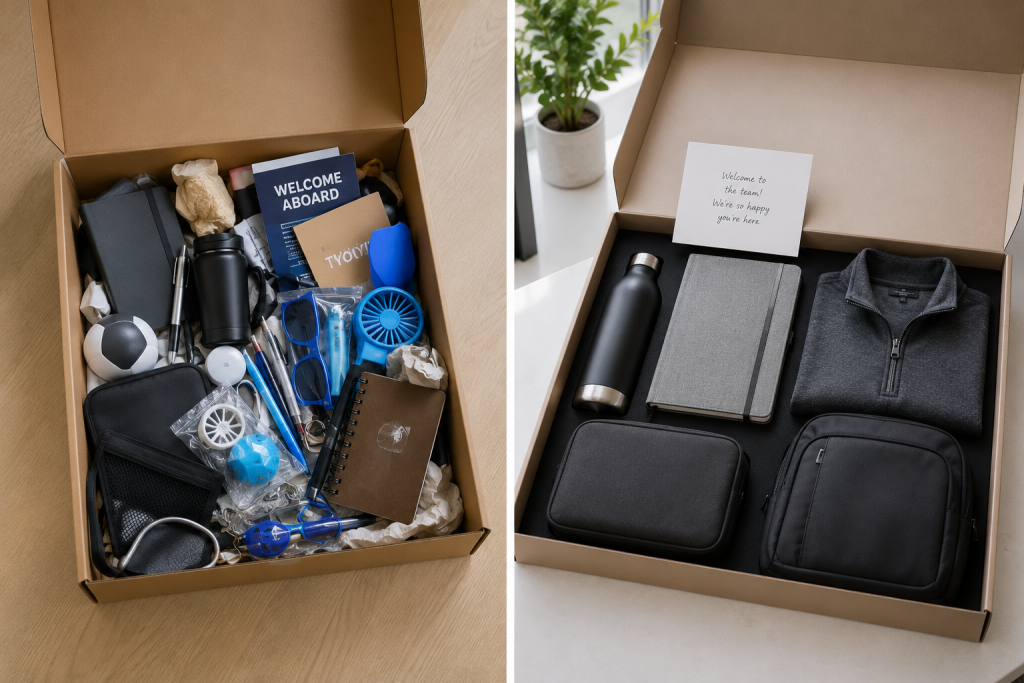
The most common onboarding kit mistakes aren’t about what’s included. They’re about what shouldn’t be.
Low-quality items with high brand visibility. A poorly made pen or a flimsy tote bag communicates more about your brand than you intend. Every item is a proxy signal for organizational quality.
Too many items. Quantity creates clutter. A focused kit of four to six high-quality items outperforms a sprawling kit of twelve mediocre ones. Employees remember curation.
Generic items with no brand connection. If the item could have come from any company, it shouldn’t be in the kit. Every item should feel intentional.
Apparel without size options. Sending a fixed-size item is a gamble that communicates carelessness when it goes wrong. If apparel is in the kit, build a size collection process into onboarding.
The Logistics Most Organizations Underestimate
Product selection is the visible part of onboarding kit planning. Logistics is where most programs fail quietly.
Fulfillment timing. New hire start dates change. Offer letters get accepted two weeks before day one, or two days before. Your fulfillment process has to accommodate both. Organizations that can’t ship kits reliably, on time, to the right address, with the right contents, undermine the investment before it lands.
Remote employee delivery. For distributed workforces, home delivery is the default. That introduces carrier variability, address accuracy requirements, and packaging standards that matter when a kit arrives on a doorstep rather than a desk.

Inventory readiness. A kit program without reliable inventory is a promise you can’t keep. Running out of a size, a style, or a core item during peak onboarding seasons is one of the most common and avoidable failures in merchandise programs. Safety stock planning, maintaining 10–20% buffer inventory per SKU, is the operational standard for programs that run reliably.
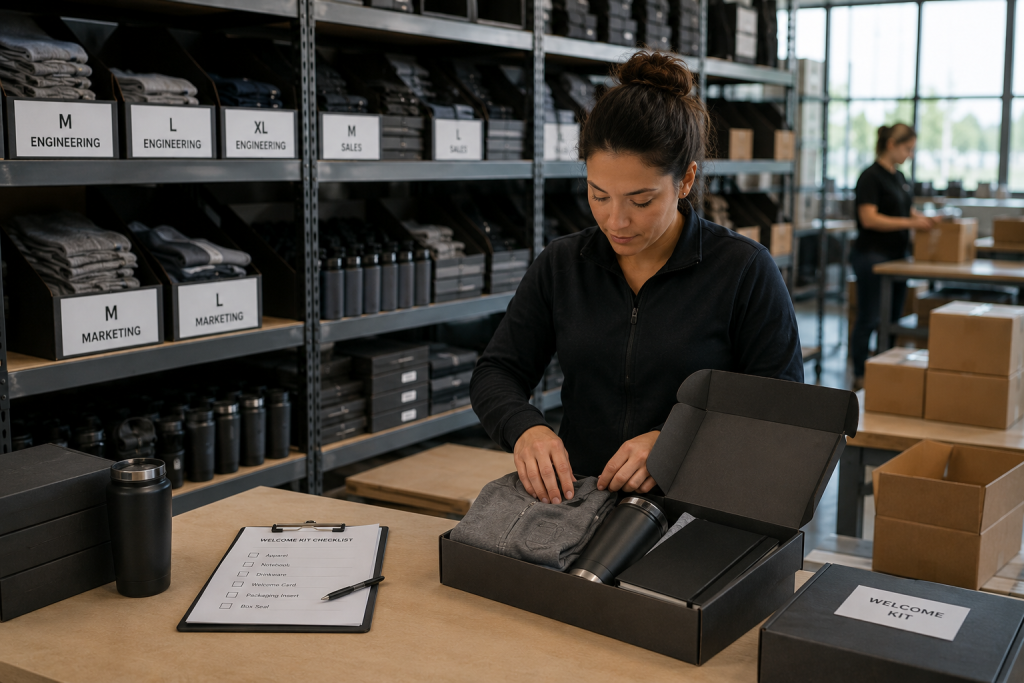
Kit assembly. Pre-kitting versus on-demand assembly involves real trade-offs in cost, flexibility, and lead time. Organizations with predictable, high-volume onboarding cohorts often benefit from pre-kitted inventory. Organizations with variable hiring need more flexible fulfillment architecture.
How to Scale an Onboarding Kit Program
What works for a 50-person onboarding kit program will break at 500. Scaling requires deliberate decisions at each inflection point.
Standardize your kit tiers. Most organizations benefit from two to three kit tiers: a standard new hire kit, a leadership or executive kit, and potentially a role-specific kit for high-visibility functions like sales or field operations. Tiers allow personalization at scale without custom kit design for every hire.
Build vendor relationships that can scale with you. Lead times, minimum order quantities, and quality consistency all behave differently at volume. Your vendor relationships need to be built for where you’re going, not just where you are.
Automate trigger points. The most scalable onboarding kit programs connect HRIS data–such as offer acceptance, start date, location, and role–to fulfillment workflows automatically. When a new hire record is created, the kit ships. Human touchpoints introduce delays.
Measure what matters. Kit delivery timing, fulfillment accuracy, employee satisfaction with kit contents, and cost per kit are the metrics that tell you whether your program is performing. Organizations that measure consistently improve consistently.
The Connection to Broader Merchandise Strategy
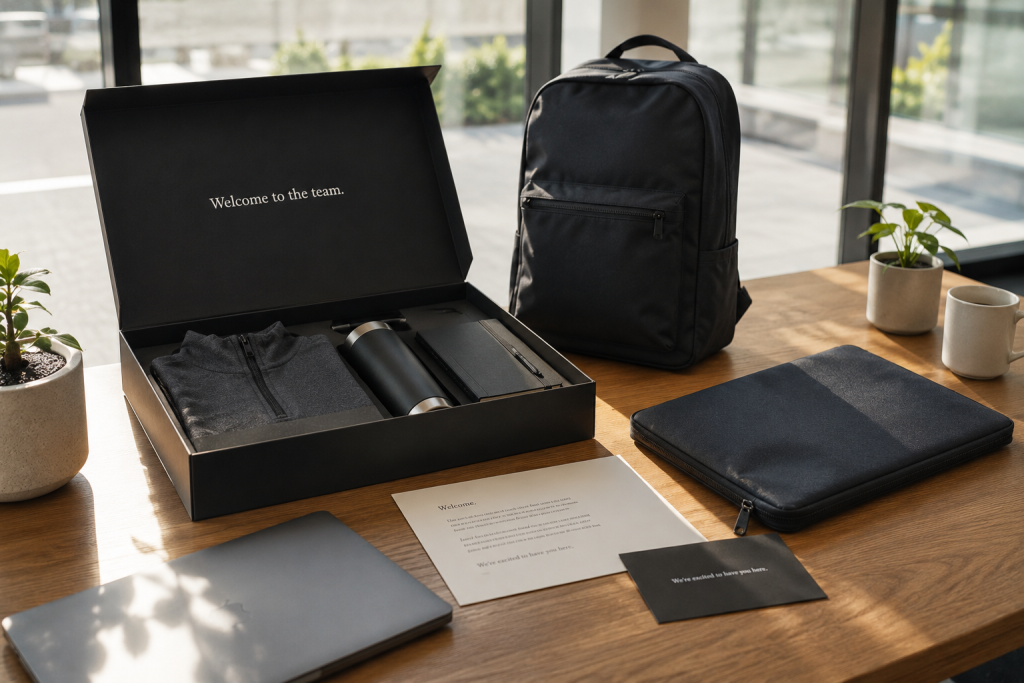
An onboarding kit is most organizations’ highest-stakes merchandise moment, but it’s rarely the only one. Recognition programs, milestone kits, event merchandise, and employee store programs all require the same operational infrastructure: inventory management, fulfillment architecture, vendor relationships, and data.
Organizations that build that infrastructure for their onboarding program find that it becomes the foundation for everything else. Organizations that treat each merchandise moment as a one-off project rebuild from scratch every time.
How IDX Can Be Your Onboarding Kit Partner
Everything in this guide: product curation, fulfillment logistics, inventory readiness, vendor scalability, is easy to describe and hard to execute consistently. That’s the gap most internal teams hit: they can design a great kit once, but they struggle to run a great kit program month after month, hire after hire.
That’s the problem IDX is built to solve.
We manage the full lifecycle of employee onboarding kits, from product sourcing and quality control, to size and inventory management, to on-demand fulfillment that ships the moment a new hire record is created. Whether you’re onboarding 5 people a month or 500, we build the operational infrastructure so your team doesn’t have to reinvent it with every hiring cycle.
What that looks like in practice:
- Curated, tiered kit design — standard, leadership, and role-specific kits, built around your brand and workforce, without needing custom design work for every hire.
- Reliable fulfillment — accurate, on-time delivery whether a kit is shipping to a corporate office or a new hire’s front porch.
- Inventory and safety stock management — so a missing size or an out-of-stock item never derails a new hire’s first day.
- HRIS-integrated automation — connecting offer acceptance and start-date data directly to fulfillment, so kits ship without manual intervention.
- Scalable vendor relationships — built to hold quality and lead times steady as your hiring volume grows.
And because onboarding is rarely the only merchandise moment that matters, the same infrastructure extends naturally to recognition programs, milestone kits, event merchandise, and employee stores, so you’re not rebuilding your operation from scratch every time a new program comes up.
If your onboarding kit program is ready to move from a one-off project to a repeatable, scalable system, IDX is ready to be that partner. Get in touch with our team to talk through what a kit program built for your organization’s scale could look like.