Running one trade show booth is manageable with a spreadsheet and a few emails. Running fifteen across different cities, teams, and shipping deadlines, is a different problem entirely.
The challenge isn’t picking the right tote bag. It’s building the operational infrastructure to get the right items, in the right quantities, to the right venue, at the right time, without your marketing team losing half their week to shipment tracking and fulfillment fixes.
This article breaks down the systems that leading brands use to manage merchandise at scale: standardized event kits, venue shipping protocols, real-time inventory visibility, and active replenishment.
Where Multi-Event Programs Break Down
Most companies don’t start with a scaling problem. They start with one event, handled manually, and it works, for a while. The cracks show up once a team is running concurrent events in three cities, supporting a flagship conference alongside eight regional roadshows, or coordinating a national product launch tour.
Four failure modes show up almost every time:
- Inventory blindness. No one has an accurate picture of what exists across the program, so items already in stock get reordered, sometimes by six different field reps who don’t know marketing already bought 2,000 units.
- Venue shipping chaos. Advance warehouse deadlines, weight limits, and carrier requirements get missed, resulting in excessive material handling fees or shipments that arrive after the booth is already open.
- Kit inconsistency. When each team member packs their own kit, brand presentation varies by person instead of by strategy, one rep skips the premium item entirely because they didn’t know it existed.
- Replenishment gaps. Without visibility into consumption, teams run out of key items mid-event with no way to resupply in time.
None of these problems solve themselves. Here’s the infrastructure that does.
1. Standardize Event Kits Instead of Assembling Them Ad Hoc
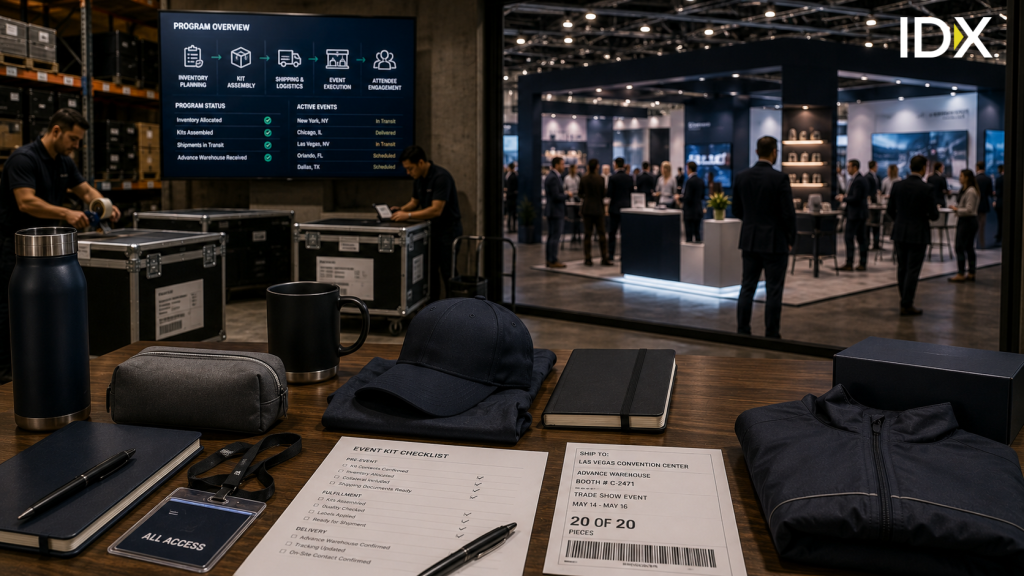
The event kit is the foundational unit of a scalable merchandise program. Instead of letting each team member build their own set of materials, define a standard, pre-configured kit for each event type or tier.
| Kit Type | Contents | Typical Use |
|---|---|---|
| Standard Field Kit | 1–2 general-tier items, collateral, branded display elements | Regional shows, roadshows, smaller conferences |
| Full Event Kit | Full tier 1–3 merchandise, signage, display hardware, premium items | Major national trade shows, flagship conferences |
| VIP Engagement Kit | Premium merchandise, personalized collateral, leave-behind gifts | Executive meetings, VIP summits, hosted events |
| Replenishment Kit | Restocked general-tier items only | Mid-event resupply for multi-day shows |

Standardized kits do three things at once: they keep brand presentation consistent regardless of who’s staffing the booth, they cut prep time since kits are pre-assembled and pulled from stock rather than built from scratch, and they create a clean ordering unit that makes forecasting and reordering far simpler.
IDX designs, assembles, and fulfills standardized event kits for clients running high-frequency event calendars. See how our custom kitting and swag box programs work.
2. Get Venue Shipping and Advance Warehouse Logistics Right
Shipping merchandise to a trade show venue is one of the most operationally complex, and costly to get wrong, parts of event logistics.
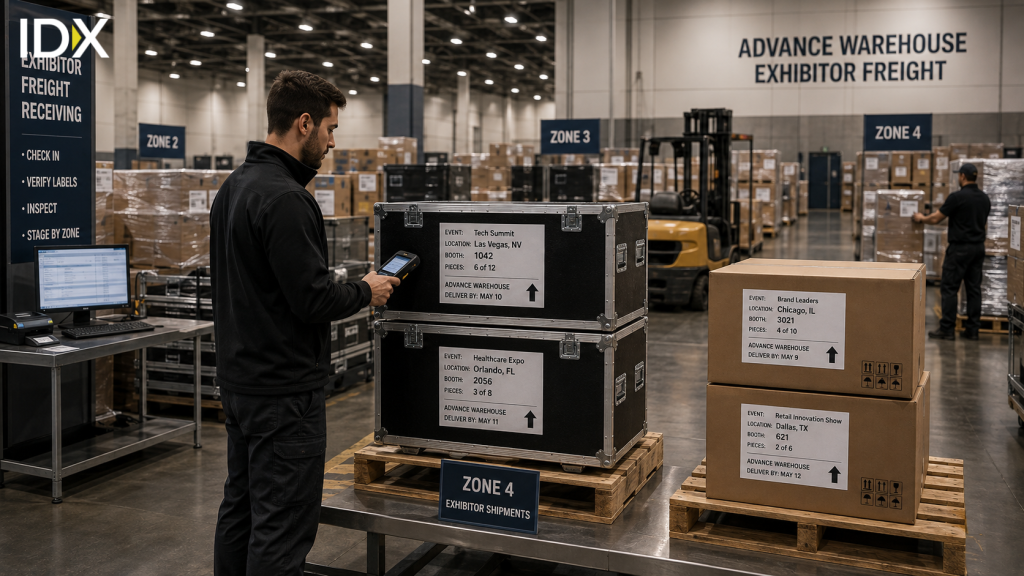
Most major shows use an official general contractor (GC) who handles freight receiving and delivery to the booth. Shipments have to land within a defined advance warehouse window (usually 2–4 weeks before the show opens), use approved carriers, and carry the correct labeling. Miss the window or the requirements, and you’re looking at delays, redirects, or steep material handling fees.
Advance warehouse shipping is almost always the safer bet. It gives you a buffer if a carrier runs late, your shipment can still land on time even with a delay. Shipping direct-to-show leaves no room for error: if something goes wrong the day of, there’s often no time to recover.

Venue shipping checklist:
- Get the advance warehouse address and delivery window from the show organizer, not the venue address; these are different
- Confirm the official general contractor and their freight requirements
- Label every shipment with exhibitor name, booth number, show name, dates, and piece count (e.g., “1 of 4”)
- Verify carrier approval. Some GCs require specific carriers or prohibit certain freight types
- Calculate material handling fees (billed by hundredweight/CWT) and build them into your event budget
- Confirm an on-site contact who will receive and sign for shipments
- Ship with tracking and confirmation, never ship blind to a venue
- Log all tracking numbers somewhere the full team can access
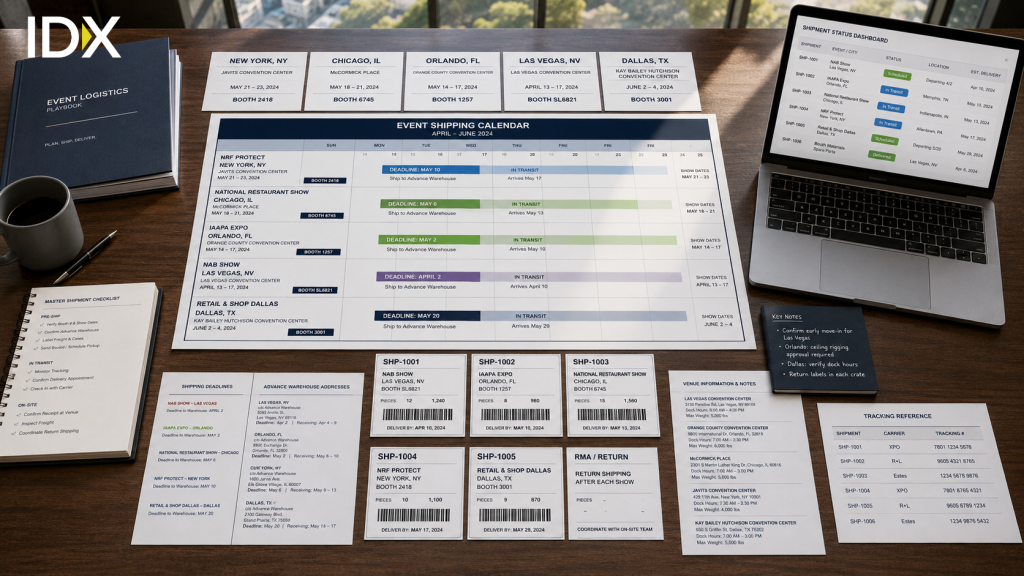
For brands running concurrent events, a shared shipping calendar: deadlines, tracking, and on-site contacts for every active show, is the bare minimum for staying in control.
3. Build Real-Time Inventory Visibility Across the Program
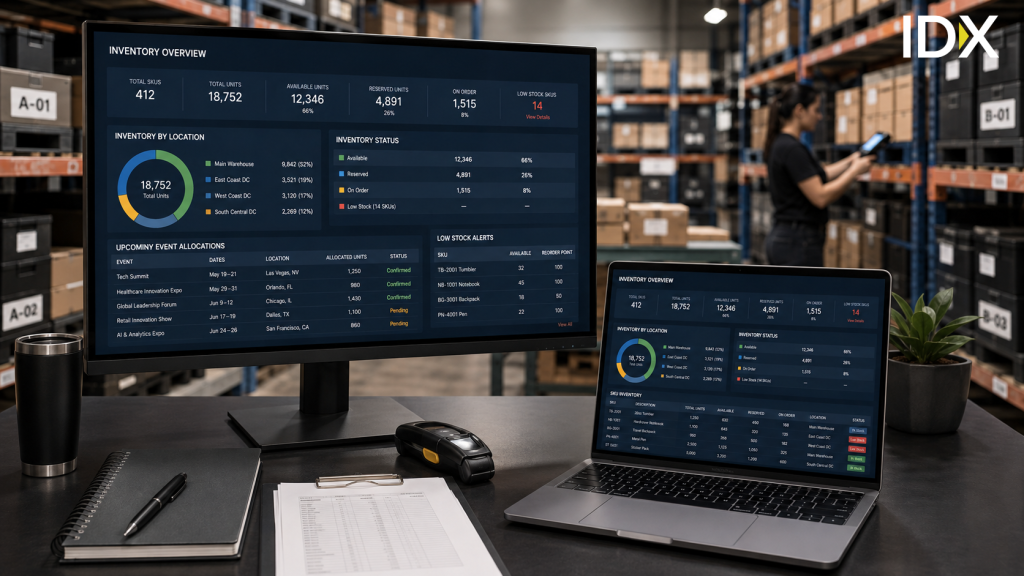
The single highest-value investment for a multi-event program is real-time inventory visibility: knowing exactly what exists, where it is, and how much has already been allocated.
In practice, most teams don’t have this. Inventory lives across warehouses, regional offices, personal spreadsheets, and institutional memory (“I think Sarah has the leftover pins from Austin”).
What replaces that patchwork:
- An inventory management system (IMS) that tracks every SKU, location, quantity, and allocation in real time, so when a kit ships, inventory decrements automatically, and when surplus comes back, it’s logged just as fast.
- Webstore integration, so available stock updates automatically, over-ordering is prevented, and reorder alerts trigger at defined thresholds.
- Daily consumption tracking at multi-day events, even a simple manual tally, to fuel replenishment decisions and sharpen future forecasts.
- Reporting by event, region, and item, which surfaces patterns individual event reviews miss: underperforming items, regions that burn through inventory fastest, kit configurations that need adjusting.
See how our inventory management and fulfillment solutions give you that visibility.
4. Put a Replenishment System in Place for Active Events
Multi-day shows, especially three-to-five-day national events, need active replenishment management. Running out of a key item on day two isn’t just a forecasting miss; it’s a replenishment failure.
| Lead Time Available | Replenishment Method |
|---|---|
| 5+ business days | Standard production and overnight ship from warehouse |
| 2–4 business days | Rush production or pull from nearest regional inventory |
| Same day / next day | Local sourcing, generic substitution, or reallocation from a lower-priority tier |
| No time | Communicate the shortage transparently; prioritize remaining stock for highest-value interactions |
Early detection is what makes replenishment work. A daily count-and-report from the booth team gives you enough signal to trigger a reorder before the shortage becomes a problem. Waiting until the table is empty makes every option worse.

Brands with an IDX-managed inventory program can trigger replenishment requests directly through the system, with same-day fulfillment for items already in the IDX warehouse.
5. Centralize Fulfillment Across Distributed Teams
For brands with regional field marketers, channel partners, or franchise locations, centralized fulfillment replaces regional chaos with one coordinated system: a single warehouse (or coordinated regional network) fulfills requests for every location.
What centralized fulfillment gets you:
- Brand standards enforced at the source, only approved items are available to order
- Budget controls built into the ordering system instead of managed through approval chains
- Shared inventory, so simultaneous regional teams stop reordering items that are already in stock
- Consolidated reporting, spend, consumption, and inventory data roll up to one view
The strongest programs give field marketers real autonomy inside defined parameters, they can order what they need, when they need it, within their event budget, without routing every request through a central team. That cuts administrative overhead on both sides while keeping the program consistent.
A Practical Operating Framework
For brands running five or more events a year, here’s a working cadence:
Quarterly
- Review the full event calendar; identify all shows, sizes, and booth types
- Assign kit tiers per event; flag anything needing custom or special-order items
- Place custom merchandise orders with 6–8 weeks of lead time minimum
- Confirm venue shipping requirements and advance warehouse deadlines
Monthly
- Run a full inventory audit and update the IMS
- Review consumption data from the prior month; adjust forecasts
- Confirm kit assembly and shipping schedules for upcoming events
- Review and update webstore inventory
Per Event
- Pull the kit from warehouse inventory; confirm contents before shipping
- Ship with full documentation: tracking, labels, on-site contact, credentials
- Run a daily inventory count protocol at the show
- Trigger replenishment if consumption outpaces projections by day two
- Complete a post-show count; return or redistribute surplus
Annually
- Audit the full program: spend by event, item performance, waste/surplus rates
- Rationalize the SKU catalog, cut chronic underperformers, formalize proven items
- Revisit kit tiers based on actual performance data
- Negotiate vendor agreements around full-year volume
The Bottom Line
Managing merchandise across multiple events isn’t a logistics problem, it’s an infrastructure problem. Brands that do it well have built systems: standardized kits, centralized inventory, documented shipping processes, and active replenishment protocols. They’ve moved from reacting to events to running a program.
That shift takes intentional investment most event marketing teams never get around to, because the next show always feels more urgent than the system underneath it.
IDX builds that infrastructure, so your team can focus on what happens at the booth instead of what happens in the warehouse. Talk to our team about your event merchandise program.
FAQ: Managing Trade Show Merchandise at Scale
How do companies manage trade show inventory across multiple events? Leading brands use centralized inventory management systems for real-time visibility into all merchandise, tracked by SKU, quantity, and allocation status. Standardized kits are assembled from centralized stock and shipped on a documented schedule, with a dedicated coordinator managing the shipping calendar and replenishment.
How do brands support multiple events simultaneously? It comes down to three things: centralized inventory that can be allocated across shows without double-counting, a fulfillment system that can ship to multiple venues in parallel, and a shipping calendar with deadlines and tracking for every active show.
What is an event kit for trade shows? A pre-configured, standardized package of merchandise, collateral, and display materials built for a specific event type or tier, assembled in advance and pulled from centralized inventory rather than built from scratch each time.
What is advance warehouse shipping for trade shows? Sending materials to an official receiving warehouse run by the show’s general contractor, within a set delivery window before the show opens. It’s generally preferred over direct-to-show shipping because it builds in a buffer against carrier delays.
How do I maintain inventory visibility across a large event program? You need a dedicated system, a purpose-built inventory platform or a structured integration with a fulfillment partner, tracking every SKU by location, quantity, and allocation status in real time, with daily consumption tracking at active events.
When should a brand consider outsourcing event merchandise management? Usually once the administrative burden of managing logistics starts competing with the team’s actual event marketing work, or fulfillment errors start affecting brand experience, typically somewhere between five and fifteen events per year.