The Flat Distribution Problem
Tiered event gifting isn’t a new idea in luxury hospitality or executive entertainment. However, it remains surprisingly rare in trade show and field marketing.
Most event teams still rely on a single merchandise budget, a single product selection, and a single distribution model. As a result, every attendee gets the same thing, no matter who they are or where they sit in the relationship.
This approach feels fair. In reality, it’s wasteful.
Consider a first-time visitor who wandered past your booth, then compare them to a customer who has renewed three times and regularly refers business. When both receive the same branded quarter-zip, two things happen. The new visitor gets more than the moment warrants, before any meaningful value exchange has occurred. Meanwhile, the loyal customer receives an unintended signal: they’re worth exactly as much as a stranger.
Neither outcome serves your brand, and both are entirely avoidable.
At IDX, we help marketing teams build event programs where every touchpoint, including merchandise, reflects the actual state of the relationship. Tiered gifting is one of the highest-leverage tools for doing that. This article explains how it works, why it matters psychologically, and how to implement it at your next event.
Why Personalization Is the Standard, Not the Exception
The expectation of a personalized experience no longer stays confined to digital marketing. It has moved fully into physical and live contexts.
According to McKinsey’s 2023 Next in Personalization report, 71% of consumers expect companies to deliver personalized interactions, and 76% get frustrated when companies don’t.
That expectation doesn’t pause at the convention center door. When a longtime customer walks into your event booth and receives the same experience as someone who just typed in their email for the Wi-Fi, they notice, even if they don’t say so.
The psychology here is straightforward. Personalization signals recognition, and recognition is one of the most powerful drivers of human loyalty. Being seen as an individual creates an emotional response that generic brand interactions simply can’t replicate.
Tiered gifting is one of the most practical, scalable ways to put that recognition to work at live events.
The Four Relationship Tiers, and What Each One Warrants
Effective tiered gifting strategies start with a simple question: what is the current state of this relationship, and what does it need to become?
For most B2B event marketing programs, that question breaks down into four natural tiers.
Tier 1: General Attendee
Who they are: First-time visitors, early-stage prospects, and walk-by traffic with unconfirmed qualification. They’ve engaged enough to stop, but the relationship hasn’t been established yet.
What the moment requires: A warm, low-pressure brand impression. The experience should communicate care and intentionality without overinvesting in a relationship that hasn’t shown a meaningful signal.
What works:

- Quality consumables: specialty coffee, premium snack kit, tin of mints
- Practical small-format items: cable organizer, microfiber lens cloth, compact notebook
- Branded content: well-designed print or digital assets that deliver genuine value
What to avoid: Big-ticket items that create no reciprocal signal. Likewise, skip cheap items that communicate low brand standards.
Investment range: $3–5 per person
The psychology: At this tier, you’re not trying to deepen a relationship. Instead, you’re trying to create a positive first impression and lower the barrier to a second interaction. A thoughtful execution at a modest investment level accomplishes exactly that.
Tier 2: Qualified Lead
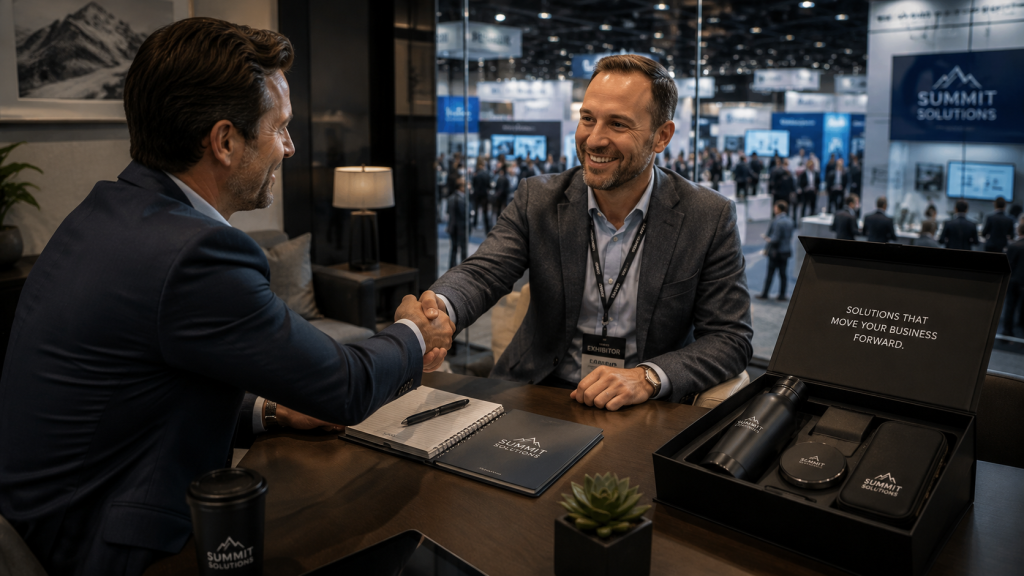
Who they are: Prospects who have shown genuine interest – a meaningful booth conversation, a demo request, a confirmed budget and timeline, or a pre-event meeting booking. These are people where a commercial relationship is plausible within the next one to three quarters.
What the moment requires: An escalation signal. The experience should communicate: we took note of this conversation, and we value where it’s heading.
What works:
- Practical mid-range utility items: premium insulated bottle, wireless charger pad, travel accessory kit
- Curated kits: a two- or three-item collection that tells a coherent brand story
- Experience extensions: access to a side event, hosted dinner invitation, priority session pass
What to avoid: Items so generic they could have come from any exhibitor. At the same time, avoid items so lavish they feel like pressure rather than appreciation.
Investment range: $10–30 per person
The psychology: A qualified lead evaluates more than your product or service. They’re also evaluating what it’s like to do business with you. A merchandise moment that reflects attentiveness and quality previews that experience, so make sure it sets the right standard.
Tier 3: Current Customer
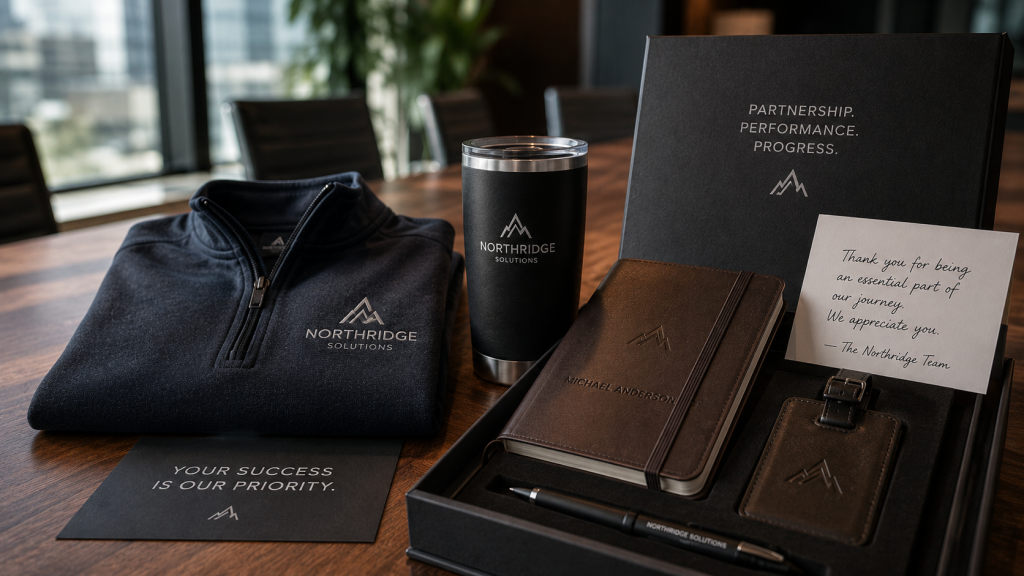
Who they are: Active customers, regardless of tenure. They’ve made a commercial commitment, they know your team, and they have expectations.
What the moment requires: Recognition that goes beyond what a stranger would receive. This is where the gap between flat distribution and tiered gifting becomes most consequential, and where many event programs miss the opportunity.
What works:
- High-quality branded apparel: quarter-zip, vest, or premium tee with restrained design
- Premium utility items: leather notebook, quality tech accessory kit, insulated bottle upgrade
- Personalized touches: their name, their team, or a reference to something specific about the relationship
What to avoid: Anything that could be described as “the same thing everyone else got.” That’s not customer appreciation, it’s customer indifference with branding on it.
Investment range: $40–80 per person
The psychology: Existing customers are often the strongest source of expansion revenue, referrals, and case study opportunities. The cost of making them feel genuinely valued at an event is small compared to the lifetime value at risk. A merchandise moment that says “we know who you are” is a relationship investment with measurable downstream returns.
Tier 4: Executive / VIP
Who they are: C-suite prospects, strategic partners, key accounts, advisory board members, or relationships where the stakes (and potential) are highest.
What the moment requires: An experience, not a transaction. This tier should never feel like it came from a product catalog. Instead, it should feel designed specifically for the recipient.

What works:
- Premium gifting: high-end leather goods, custom-configured tech, curated lifestyle items
- Experience-based gifting: private dinner, exclusive access, bespoke itinerary, VIP hospitality suite
- Custom packaging and personalization: their name, a handwritten note, or a reference to shared context
- Post-event follow-through: a gift that continues or unlocks something after the event ends
What to avoid: Anything that reads as “expensive but generic.” A $150 item pulled from a shelf and decorated with a logo isn’t a VIP experience, it’s just a pricier version of what everyone else got.
Investment range: $100–250+ per person, or equivalent experiential value
The psychology: At this tier, the merchandise is almost beside the point. What matters most is whether the recipient feels genuine thought went into their experience. The signal of time, attention, and intentionality is worth more than any product specification.
The Tiered Gifting Matrix
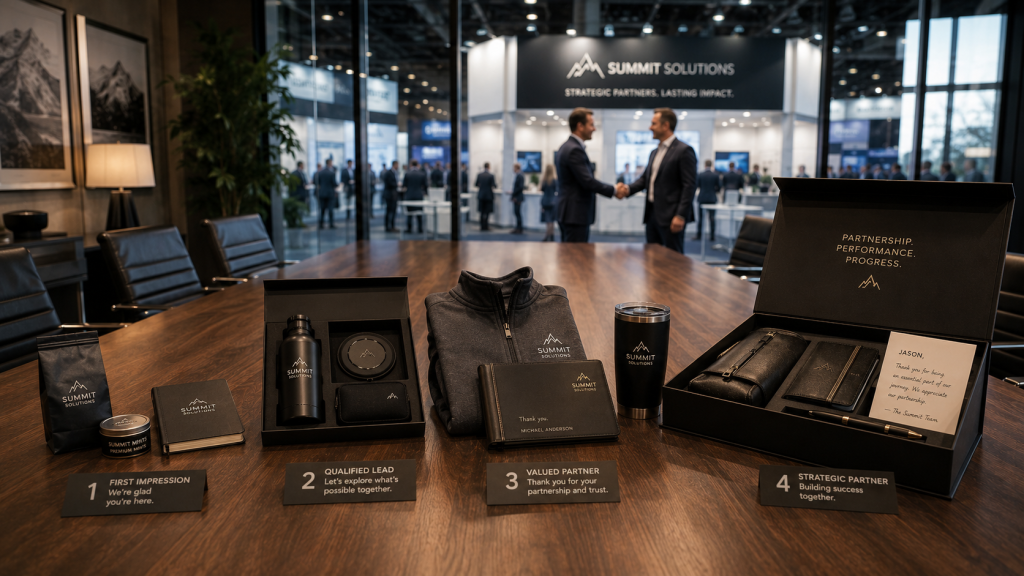
| Tier | Who They Are | Core Goal | Merchandise Type | Investment Range |
|---|---|---|---|---|
| General Attendee | Walk-by traffic, unqualified prospects | Positive first impression | Consumables, small utility items | $3–5 |
| Qualified Lead | Active prospect, demo completed, meeting booked | Escalation signal, memorable brand touchpoint | Premium utility, curated kits | $10–30 |
| Current Customer | Active account, any tenure | Recognition, loyalty reinforcement | Quality apparel, personalized items | $40–80 |
| Executive / VIP | C-suite, strategic account, key partner | Bespoke experience, relationship deepening | Premium gifting, experiences, custom packaging | $100–250+ |
The Operational Challenge, and How to Solve It
The most common objection to tiered gifting is operational. How do you know who’s who at the booth? How do you execute different experiences without making the process feel awkward?
This is a real challenge, but it’s also a solvable one. Solving it is where event infrastructure expertise becomes essential.
Pre-event segmentation. Work with your CRM and demand generation teams before the event to tag registered attendees by relationship tier. Most event registration platforms support custom fields or list segmentation, and that information can then feed into badge scanning or check-in workflows.
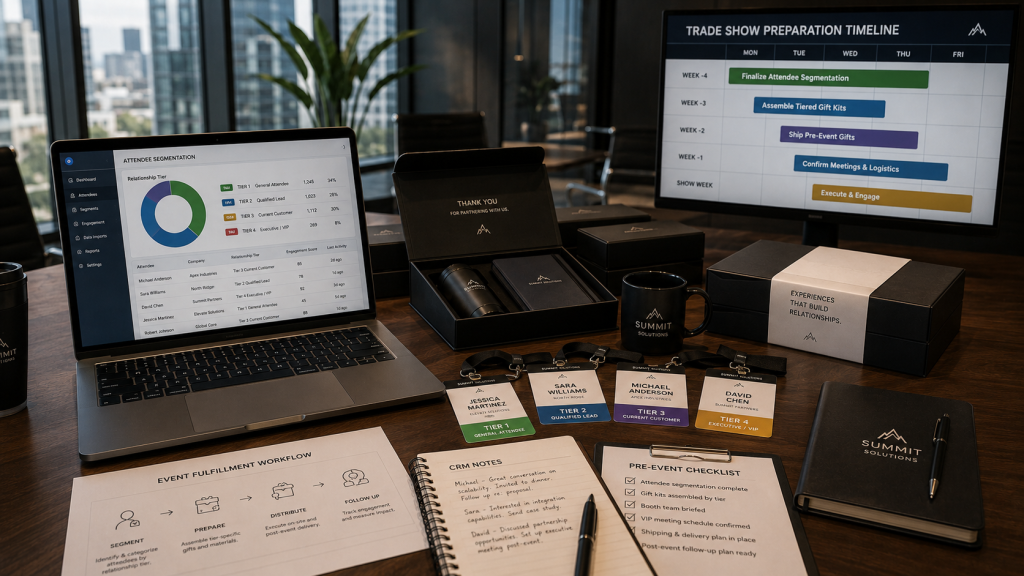
Booth staff briefing. Equip your booth team with a simple qualification framework. Three to five questions can help staff assess relationship tier in real time for unregistered walk-ins, and the process doesn’t need to feel formal. It can be conversational.
Discreet distribution design. Tier distribution doesn’t have to be visible to attendees. Higher-tier merchandise can be stored separately, offered in a private meeting space, or delivered after the event. In fact, removing public comparison can actually increase the impact of personalization.
Post-event fulfillment. For executive and VIP tiers, post-event delivery often outperforms on-site distribution. It extends the touchpoint beyond the noise of the event floor, and more importantly, the gift arrives when the recipient has the cognitive space to appreciate it.
IDX helps marketing teams design and execute the operational infrastructure behind tiered gifting, including pre-event segmentation, on-site logistics, and post-event fulfillment.
Explore IDX event strategy and activation services →
Tiered Gifting Implementation Checklist
Before your next event, use this checklist to build a tiered gifting program:
- Have you defined the four relationship tiers relevant to this event and audience?
- Have you pre-segmented registered attendees by tier using CRM data?
- Does each tier have a distinct merchandise or experience selection?
- Is the quality gap between tiers meaningful, not just marginal?
- Have you briefed booth staff on real-time qualification criteria for walk-in attendees?
- Is the distribution workflow discreet where visibility could create awkwardness?
- Have you considered post-event fulfillment for executive and VIP tiers?
- Does the total program budget reflect relationship value, not just unit cost?
FAQ: Tiered Event Gifting and Personalized Event Experiences
What is a tiered event gifting strategy?
A tiered event gifting strategy assigns different merchandise, experiences, or gift values to attendee categories based on their relationship with the brand. Typical tiers include general attendees, qualified leads, current customers, and executives or VIPs. The goal is simple: the depth of investment in a merchandise moment should reflect the depth of the relationship.
Why shouldn’t all event attendees receive the same merchandise?
Flat distribution treats every attendee as interchangeable, and that creates two problems. First, it overinvests in unqualified relationships. Second, it underinvests in valuable ones. Research consistently shows that personalization drives loyalty, and a lack of recognition can frustrate existing customers. Tiered gifting addresses both problems at once.
How do I operationalize tiered gifting at a busy trade show booth?
Start with pre-event segmentation by using your CRM to tag registered attendees by tier. Then, brief booth staff with a short qualification framework for walk-ins. Finally, design discreet distribution workflows; higher-tier merchandise can be kept in a private meeting area or delivered after the event. The operational lift is manageable, and the potential return outweighs the added complexity.
What should executive or VIP event gifts look like?
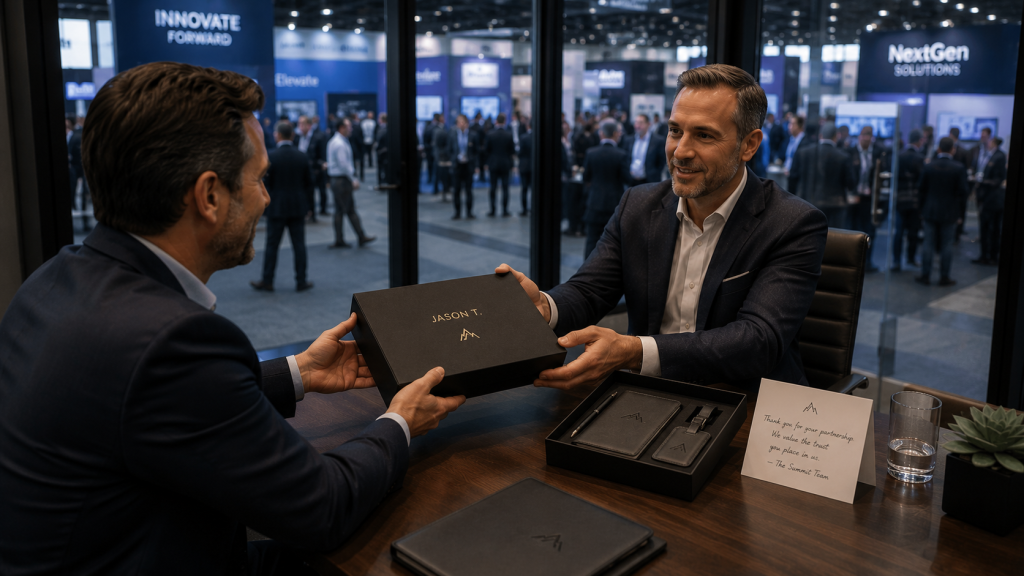
VIP event gifts should feel bespoke, not expensive-but-generic. Personalization matters more than price point, so consider including a name, a custom element, or a reference to the specific relationship. Experience-based gifting can also outperform product gifting at this tier: think private dinners, exclusive access, or curated itineraries. Post-event delivery is another strong option, since the recipient often has more cognitive space to appreciate the experience once the event ends.
How do I calculate the right investment per tier?
Start with relationship value, not product cost. Ask what the average lifetime value of a customer is at this stage, what losing them would cost, and what expanding the account could be worth. Merchandise investment should scale with that value. For example, a $75 gift to a customer worth $200,000 in annual revenue isn’t a significant expense; it’s a relationship signal with strong ROI.
How does IDX approach tiered gifting differently from a promotional products vendor?
IDX treats tiered gifting as an experience design challenge, not a sourcing challenge. We start with relationship mapping, attendee psychology, and brand impression goals, and from there, we design merchandise tiers, operational workflows, and distribution moments that support those goals. The product comes last, not first.
Personalization at Scale Is a Strategic Capability
The shift from flat distribution to tiered gifting isn’t primarily a budget decision, it’s a strategic one. It requires knowing your audience well enough to segment them, caring enough about the relationship to invest differently at each stage, and having the operational discipline to execute that intent on a busy event floor.
Most event teams skip this because it’s harder than ordering 500 of the same item. But “harder than the default” is a low bar.
The brands that clear it create something flat distribution never can: the experience of being genuinely known. That experience, at the right moment, for the right person, is worth more than any merchandise budget.
IDX designs tiered event experiences, activation infrastructure, and merchandise strategies for marketing teams that treat personalization as a competitive advantage.