A Cost Center or a Strategic Asset?
Employee store optimization strategies are no longer a “nice to have” for HR, total rewards, and brand teams. Instead, they’re a financial necessity. A poorly optimized employee store quietly drains budget through unused inventory, low adoption, and clunky fulfillment. A well-optimized one, on the other hand, becomes a measurable driver of culture, retention, and brand consistency.
At IDX, we’ve spent years helping organizations rebuild their employee stores from cost centers into strategic assets. Along the way, the patterns behind that transformation have proven remarkably consistent. This guide breaks down exactly what separates a thriving employee store from a stagnant one, and it gives you a repeatable framework to apply immediately.
Why Employee Store Optimization Matters in 2026
Employee stores have evolved well past “swag closets.” Today, they sit at the intersection of recognition programs, onboarding kits, sustainability commitments, and employer branding. According to internal benchmarking IDX has conducted across client programs, the average organization launches an employee store with strong initial enthusiasm. Without an optimization plan, however, engagement typically drops 30–50% within the first 18 months.

The causes are predictable: stale inventory, poor personalization, hidden friction in checkout or shipping, and a lack of data feeding decisions back into the program.
Optimization closes that gap. Specifically, it’s the ongoing discipline of using data, design, and operational rigor to keep an employee store relevant, cost-efficient, and genuinely valued by the people it serves.
The Business Case: What’s Actually at Stake
Before diving into tactics, it’s worth quantifying why this matters. Three categories of cost or value are directly tied to how well an employee store is optimized:
| Business Area | Impact of Poor Optimization | Impact of Strong Optimization |
|---|---|---|
| Inventory & Budget | Excess stock, write-offs, rushed reorders | Predictable demand, reduced waste, healthier margins |
| Engagement & Culture | Low redemption rates, disconnect from brand | Higher participation, stronger sense of belonging |
| Operations & HR Time | Manual fulfillment, ticket-driven support | Self-service workflows, automated reporting |
When these three areas are misaligned, the employee store becomes a line item nobody wants to defend in budget season. Conversely, when they’re aligned, it becomes evidence of program ROI that HR and finance leaders actually want to showcase.
The IDX OPTIMIZE Framework
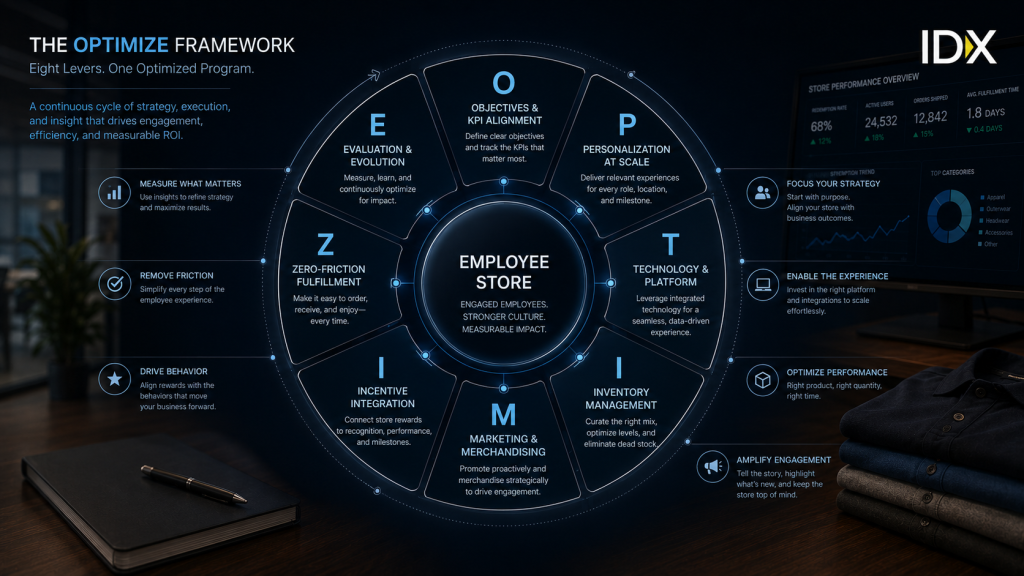
IDX developed the OPTIMIZE framework after auditing dozens of employee store programs across industries. It distills optimization into eight controllable levers. Unlike generic “best practices” lists, though, each lever maps to a specific, measurable action your team can take this quarter.
O — Objectives & KPI Alignment
Every optimization effort should start with a clear answer to one question: what is this store actually for? Retention? Onboarding consistency? Sustainability messaging? Brand visibility at events? Without a defined objective, every other decision (catalog, budget, design), becomes guesswork. So, set 2–3 primary KPIs (redemption rate, cost per redemption, employee satisfaction score) and revisit them quarterly.
P — Personalization at Scale
Generic catalogs underperform. In fact, stores segmented by role, location, tenure, or team consistently see higher engagement, because employees see relevant items rather than wading through irrelevant SKUs. Personalization doesn’t require a massive tech lift, either. Even basic segmentation (new hire vs. tenured employee, remote vs. office-based) meaningfully improves redemption.
T — Technology & Platform Architecture
The platform itself is either an accelerant or a bottleneck. To optimize effectively, you need a platform that supports real-time inventory visibility, mobile-first browsing, single sign-on, and integration with HRIS or recognition platforms. If your team is manually reconciling spreadsheets to track redemptions, the technology layer is the first thing to fix.
I — Inventory Curation & Lifecycle Management
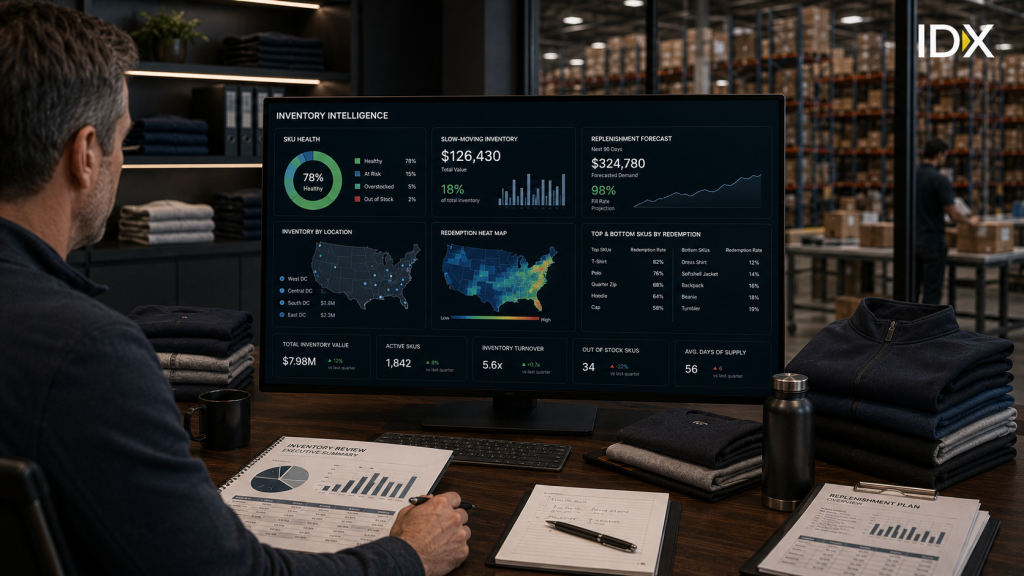
Inventory should be treated like a living catalog, not a one-time order. A simple lifecycle rule works well here: review SKU performance every 90 days, retire the bottom 15–20% of underperforming items, and rotate in seasonal or milestone-specific products. Ultimately, stale catalogs are one of the single biggest drivers of declining engagement.
M — Marketing, Merchandising & Communication Cadence
Even a perfectly curated store fails silently if nobody knows it exists or has been refreshed. That’s why internal communication deserves the same rigor as external marketing: launch announcements, milestone-triggered nudges (anniversaries, promotions), and visual merchandising that highlights new or limited items.
I — Incentive Integration
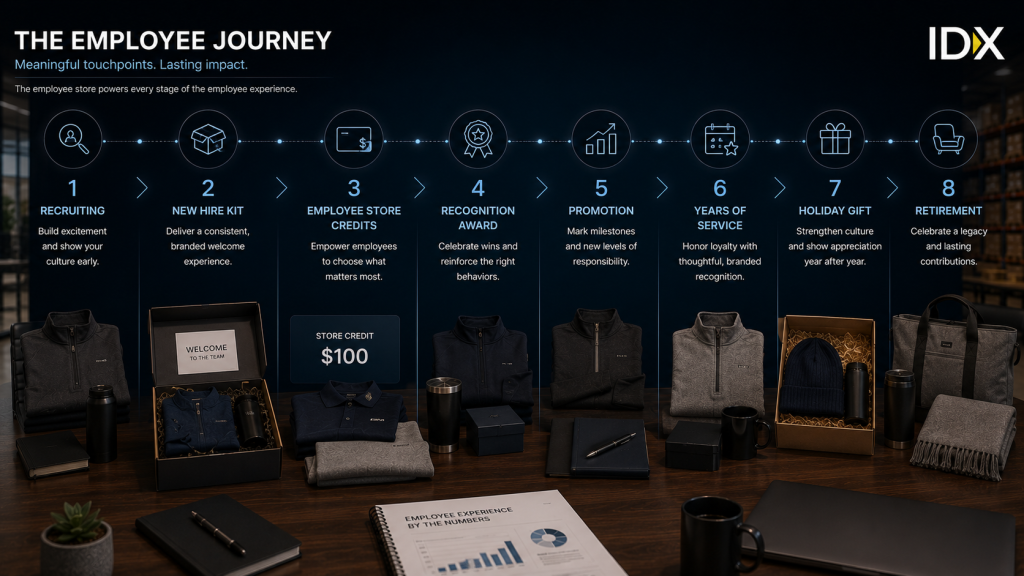
The highest-performing employee stores aren’t standalone. Rather, they’re integrated with recognition programs, wellness incentives, or performance milestones. By linking store credits to specific behaviors (peer recognition, safety milestones, tenure anniversaries), you transform the store from a static catalog into an active engagement mechanism.
Z — Zero-Friction Fulfillment & Checkout

Every additional click, manual approval, or shipping delay reduces redemption. So, audit your checkout flow the way an e-commerce team would. How many steps does it take to redeem an item? Is shipping cost or timeline a barrier? Is there a mobile-optimized experience? Even reducing friction by one or two steps can measurably increase completion rates.
E — Evaluation, Reporting & Continuous Iteration

Optimization is not a one-time project. Instead, establish a recurring reporting cadence: monthly operational metrics and quarterly strategic reviews, so the store evolves alongside employee expectations and budget realities rather than requiring a full relaunch every few years.
Employee Store Optimization Checklist
Use this as a working audit. If you can’t confidently check off most of these, you’ve found your next quarter’s priorities.
- Defined primary objective and 2–3 measurable KPIs for the store
- Inventory reviewed and refreshed within the last 90 days
- Bottom-performing SKUs identified and retired
- Store segmented by at least one employee attribute (role, location, tenure)
- Mobile experience tested for browsing and checkout
- Checkout flow audited for unnecessary steps or approvals
- Communication calendar in place (launch, milestones, refreshes)
- Store integrated with at least one recognition or incentive trigger
- Reporting dashboard reviewed monthly by program owner
- Employee feedback loop (survey or comment mechanism) actively collected
Common Pitfalls That Undermine Optimization
Most underperforming employee stores share the same handful of mistakes. Specifically, teams treat the catalog as “set it and forget it,” underestimate how much friction in checkout suppresses redemption, fail to connect the store to broader recognition strategy, and skip assigning clear internal ownership for ongoing iteration. In short, optimization fails most often not from lack of effort, but from lack of a recurring process. That’s exactly why the OPTIMIZE framework is built around a continuous cycle rather than a one-time fix.
How IDX Approaches Employee Store Optimization
IDX partners with organizations to operationalize the OPTIMIZE framework end-to-end. This spans everything from platform architecture and inventory strategy to integration with recognition systems and ongoing performance reporting. Rather than treating the employee store as a static vendor relationship, IDX positions it as a living program with the same rigor applied to retention strategy or compensation design. That’s the shift we encourage every client to make: stop asking “do we have an employee store?” and start asking “is our employee store working as hard as the rest of our people strategy?”

Frequently Asked Questions
What is employee store optimization? Employee store optimization is the ongoing process of improving an employee store’s inventory, technology, personalization, and fulfillment to increase engagement and reduce wasted spend. It treats the store as a living program rather than a one-time setup, using data and recurring review cycles to keep it relevant.
How often should a company audit its employee store? Most organizations benefit from a lightweight monthly operational check (redemption rates, inventory levels), paired with a deeper quarterly strategic review of catalog performance, communication effectiveness, and KPI alignment. Annual-only reviews, however, tend to let engagement decline unnoticed for too long.
What metrics indicate a successful employee store? Key metrics include redemption rate (the percentage of eligible employees who use the store), cost per redemption, repeat usage rate, and employee satisfaction with the program. Tracking these together, rather than any single metric in isolation, gives the clearest picture of program health.
How much should a company budget for an employee store program? Budgets vary widely by organization size and goals. That said, the more important question is allocation efficiency: well-optimized programs spend less on excess inventory and manual fulfillment. As a result, they free up budget for higher-impact items like personalization or recognition integration.
What’s the difference between an employee store and a company store? The terms are often used interchangeably. Generally, though, “employee store” emphasizes internal recognition, onboarding, and engagement use cases, while “company store” can also include external-facing branded merchandise for customers or partners. Either way, optimization strategies overlap significantly between the two.
Does personalization really improve employee store engagement? Yes. Segmenting a catalog by role, location, or tenure consistently increases redemption rates compared to a one-size-fits-all catalog. That’s because employees are more likely to engage with items that feel relevant to their specific role or milestone.
What’s the biggest mistake companies make with employee stores? The most common mistake is launching a store and never revisiting the catalog, communication, or fulfillment process afterward. Without a recurring optimization cycle, even a well-designed store will see declining engagement within 12–18 months.
Final Thought
Employee store optimization strategies work best when treated as an operating discipline, not a one-time project. The organizations that get the most value from their stores are the ones that revisit objectives, refresh inventory, reduce friction, and tie the experience back into broader recognition and culture goals, quarter after quarter. That’s precisely why IDX built the OPTIMIZE framework: so that discipline doesn’t require reinventing the wheel every time. Start with the checklist above, identify your biggest gap, and build from there.