Schools prepare everything for the first day of class. But the one thing that most influences whether a student feels like they belong? It rarely makes the planning doc.
Every August, schools invest enormous time preparing students for a successful year. Orientation schedules. Classroom assignments. Teacher training. Student handbooks. Administrators spend weeks making sure the academic experience is ready to go the moment students walk through the door.
Yet one of the biggest influences on whether a student actually feels like they belong on that first day often receives very little attention.
What they wear.
Not a uniform policy. Not a dress code. The thing that students choose, the hoodie in the school colors, the tee from the team they just made, the hat with the logo they’re proud to rep. That small, seemingly superficial detail does something that no orientation packet or welcome assembly can fully replicate: it gives a kid a visible, wearable signal that they’re part of something.
For schools and districts that want to strengthen student engagement, reduce first-day anxiety, and build a culture that families actually feel proud of, this is worth paying attention to.
Families Are Already Voting With Their Wallets

Parents don’t need a study to tell them back-to-school shopping carries emotional weight. But the scale of it is worth noting. According to the National Retail Federation’s 2025 back-to-school survey, K-12 households plan to spend an average of $858 per student on clothing, shoes, supplies, and electronics, pushing total national back-to-school spending toward $39.4 billion. Two-thirds of families had already started shopping by early July, the earliest start NRF has on record.
That’s not a society casually picking up pencils. That’s millions of families investing significant time and money into getting their kids ready, not just academically, but socially. And a meaningful share of that spending is going toward clothing that helps kids show up looking and feeling like they belong.
The question for schools isn’t whether parents are spending on this. They clearly are. The question is whether schools are making it easy for that spending to land on something that actually reinforces the school community, or whether families are left to piece together “school pride” from whatever they can find at Target.
Clothing Is How Kids Signal Belonging Before They’ve Said a Word
Long before students can articulate ideas like identity or school culture, they understand them through what they wear. A hoodie in the right colors. A jersey for the team they just made. A shirt from a school they’re genuinely excited to attend. These aren’t vanity purchases. They’re a kid’s way of saying, out loud, without words: I’m part of this.
Research backs this up. Studies on school clothing and belonging consistently find that what students wear, and whether it connects them to their school community, has a measurable effect on how included they feel. One widely cited study following more than 6,000 students found that when kids lost the ability to express themselves through clothing, they reported meaningfully lower levels of school belonging, even when their academic performance and behavior stayed the same. The researchers’ conclusion was direct: self-expression through clothing is part of how students connect to their school community.
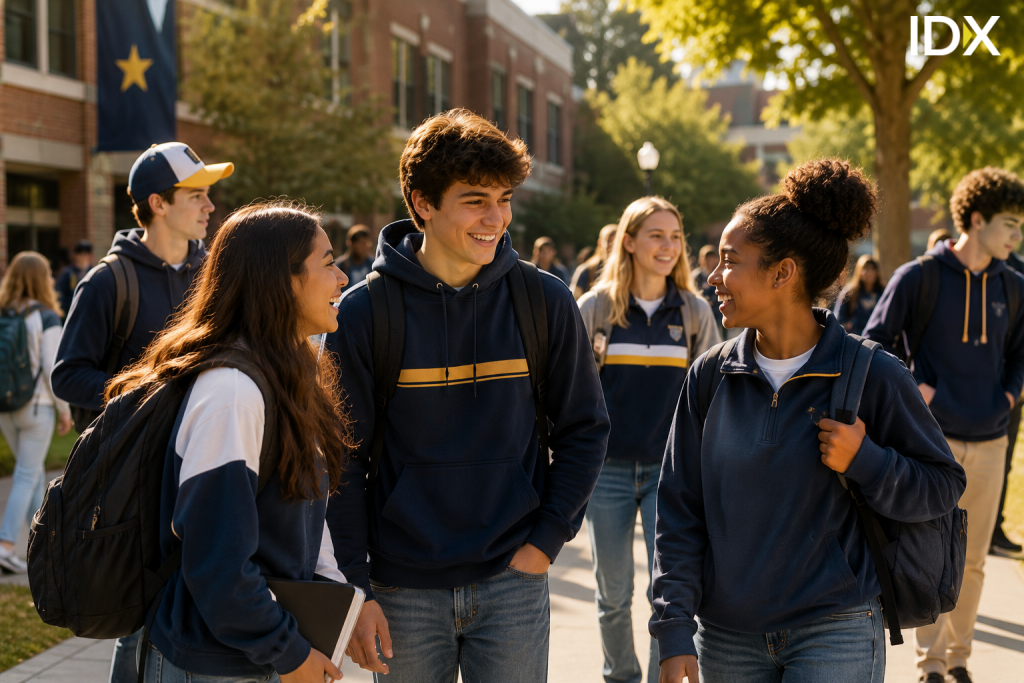
The effect flips when clothing reinforces group identity rather than suppressing individuality. Middle schoolers wearing branded, team-style attire (gear that signals we, not just me) reported stronger perceptions of school belonging compared to peers in standard dress. The difference wasn’t conformity. It was chosen belonging.
That’s exactly where spirit wear lives. And it’s why the question of whether your school makes it easy to get is more than a logistics issue.
What It Actually Looks Like From a Student’s Perspective
I’m 17 and still close enough to the back-to-school experience to tell you exactly what this feels like from the inside.
Back-to-school shopping with my parents was a full production. The problem was never finding supplies, it was the overwhelming number of options for everything that felt like it said something about me. The wrong folder choice could feel catastrophic. The backpack had to be right. Everything had to match some internal vision I had of who I wanted to be that year. My parents found this completely exhausting. To them, we were checking items off a list. To me, every decision was a small piece of showing up correctly.
What would have actually cut through all of that? Gear that was already the answer. A hoodie that already had my school’s name on it. A bag in the right colors. Something that said, here’s exactly how to rep where you go. No guesswork, no five-store odyssey, no negotiating with my parents over whether something “matched” the school aesthetic. The decision would have been easy because the identity was already built in.
That’s the version of back-to-school shopping that schools can actually enable. And most aren’t.
The Operational Gap Schools Don’t Always See
For school administrators, athletic directors, and PTO leaders, the spirit wear problem usually looks like a logistics headache: too many one-off orders, inconsistent vendor quality, sizing confusion, pop-up sales that create a rush and then disappear. But the downstream effect is bigger than that. When spirit wear is hard to access, only the most motivated families track it down. Everyone else opts out, not because they don’t care, but because it isn’t easy enough.
A year-round online school store changes that equation entirely. Instead of a seasonal scramble, families can browse and order on their own schedule. Instead of mismatched gear from a dozen vendors, every item reflects the same brand standard. Instead of fielding endless “can we still get one?” emails after a pop-up sale closes, your team has a self-service system that works without constant management.

It also solves the consistency problem that matters to schools at scale. Districts running spirit wear programs for athletics, clubs, PTO fundraisers, and general school pride often end up with gear that doesn’t match: different logo treatments, off-brand colors, quality that varies by vendor. A centralized fulfillment approach means every item, regardless of which team or program ordered it, reflects the same identity. Students see one school. Not a patchwork of programs.
School Spirit Has Measurable Returns
It’s tempting to treat student belonging as a feel-good outcome that’s hard to measure. But the data suggests it connects directly to results schools track. Research drawing on a study of more than 1,000 students, parents, coaches, and administrators found a consistent link between school spirit and student wellbeing. Students who feel strong school spirit also report stronger academic and social outcomes. One analysis found that schools that invested in spirit-driven engagement saw participation in school events climb by roughly 15%.

For enrollment-focused teams, the signal starts even earlier. A prospective student visiting campus and seeing well-made, consistent spirit wear absorbs a message instantly: this is a place people are proud of. That impression doesn’t require a brochure or a pitch. It’s already there in the gear people are wearing.
Branded merchandise isn’t decoration layered on top of school culture. For a lot of students, it’s one of the most tangible expressions of school culture they can actually carry with them.
Every Student Deserves an Easy “Yes”
Not every family has the bandwidth to spend three Saturdays hunting down school-branded gear before the first day. When schools make spirit wear genuinely accessible (easy to find, fairly priced, simple to order), they remove a barrier that quietly keeps some students from showing up the way they want to. Every kid gets an easy path to walking in on day one looking like they belong.
That’s the real case for a thoughtful spirit wear program. Not more merchandise for the sake of it, but fewer families left on their own to recreate school pride from scratch, and more students who get to start the year already feeling like part of something.
Ready to Build a Spirit Wear Program Your School Can Be Proud Of?
If your school, district, or university is ready to make spirit wear easier to access and easier to manage, IDX works with education teams to build programs that are consistent, on-brand, and actually simple to run. From year-round online school stores to kitted welcome and spirit packs, we take the August scramble off your plate and give every student a clear, easy way to show up proud.
Talk to our team about a spirit wear program for your school →