You only get one first day of school. Not one first week, one first day, and really, one first fifteen minutes of it. That’s how long it takes for a nervous kindergartner, an anxious transfer student, or a first-generation college freshman to decide something they won’t say out loud: whether this place feels like theirs. As someone who was once a young child and had to learn an entirely new language and adapt to a new environment, those first 15 minutes were huge for me.
Psychologists have a name for how fast that judgment happens. It’s called thin-slicing: the brain’s ability to form a lasting impression from just a few seconds of observation, well before conscious reasoning catches up. Princeton researchers Janine Willis and Alexander Todorov found that it takes as little as a tenth of a second to form an impression of someone, and that spending more time looking doesn’t meaningfully change that first read. Whatever a student and their family feel walking through your doors on day one, they’ll spend the rest of the semester confirming.
That’s the real challenge of back-to-school season. It isn’t logistics, though there’s plenty of that. It’s that the emotional outcome of the year is being decided before first period even starts, and most schools are pouring their planning energy into everything except those first fifteen minutes.
What the Data Says
The stakes of that first impression aren’t just emotional. They show up in the numbers all year long. According to the CDC, students who feel more connected to school are more likely to have higher grades and test scores, better attendance, and higher graduation rates, and are less likely to experience emotional distress. On the flip side, disconnection has real cost: school systems nationwide are still fighting elevated chronic absenteeism, and an analysis by Panorama Education of data from 7,000 schools and 11 million students found that positive school conditions significantly lowered chronic absence, with feeling safe at school being especially critical for elementary and middle school students.
The takeaway: belonging isn’t a “nice to have” that shows up in a satisfaction survey months later. It’s a leading indicator of attendance, achievement, and retention, and it starts forming the moment a student walks in the door.
What the Research Tells Us About Belonging
Students who feel connected to school are more likely to have positive attendance, educational, behavioral, and health outcomes well into adulthood, according to research compiled by the GRAD Partnership. Researchers studying chronic absenteeism have reached a similar conclusion from a different angle: a sense of belonging and engagement is foundational to regular attendance and credit attainment, and regular attendance is itself one of the strongest predictors of on-time graduation.
Put those two findings together and a pattern emerges. Belonging isn’t the reward for a good year, it’s the precondition for one. And belonging isn’t built in a single assembly or a single welcome letter home. It’s built in small, sensory, repeatable moments: a name said correctly, a smiling face at the door, a shirt or a lanyard that says you were expected. Those are the moments a first-day walkthrough can actually control.

Why the Small Moments Matter So Much
Ask any veteran kindergarten teacher, elementary counselor, or college orientation leader what actually happens in those first fifteen minutes, and you’ll hear some version of the same story: a family lingering by the door, a student gripping a parent’s hand a little too tightly, a freshman scanning a sea of unfamiliar faces looking for one sign that they belong here.
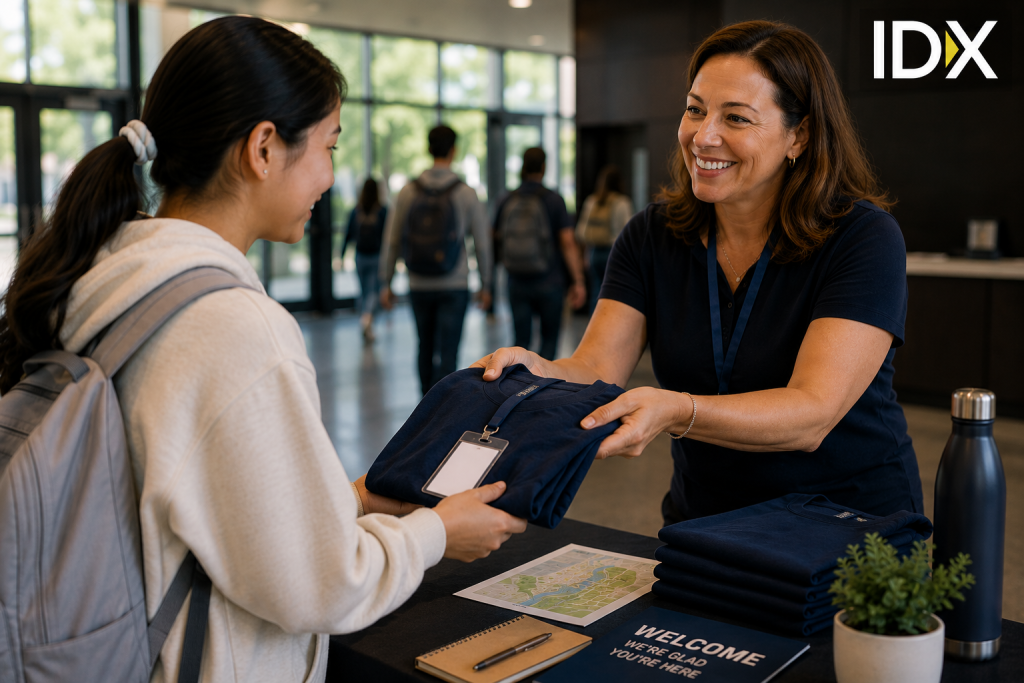
What consistently breaks that tension isn’t a speech. It’s something small and physical: a staff member who greets a new student by name, a welcome kit waiting on a dorm room desk, a T-shirt handed to a kindergartner that instantly makes them look like they belong with the rest of their class. These moments work because they give an anxious student (and an anxious parent watching from the doorway) something concrete to hold onto: proof, in their hands, that this school was ready for them specifically. That’s the emotional handoff that turns “I don’t know anyone here” into “I already have something everyone else has too.”
Where the Operational Solution Comes In

This is where thoughtful merchandise planning stops being a “spirit wear” line item and starts being part of your first-impression strategy. The schools and districts that get this right treat the first fifteen minutes as a designed experience, not an improvised one, and branded merchandise is one of the most cost-effective tools they have to do it.
A few ways this shows up in practice:
- Orientation and welcome kits assembled and ready before a single family walks in, so new students and incoming freshmen have something tangible in hand within their first few minutes on campus.
- Consistent, on-brand spirit gear distributed at kindergarten round-up, new-student orientation, or freshman move-in, so every student looks and feels like they already belong to the community.
- District- or campus-wide brand consistency, so the same warm, recognizable identity greets a family whether they’re at the elementary school, the high school, or the admissions office.
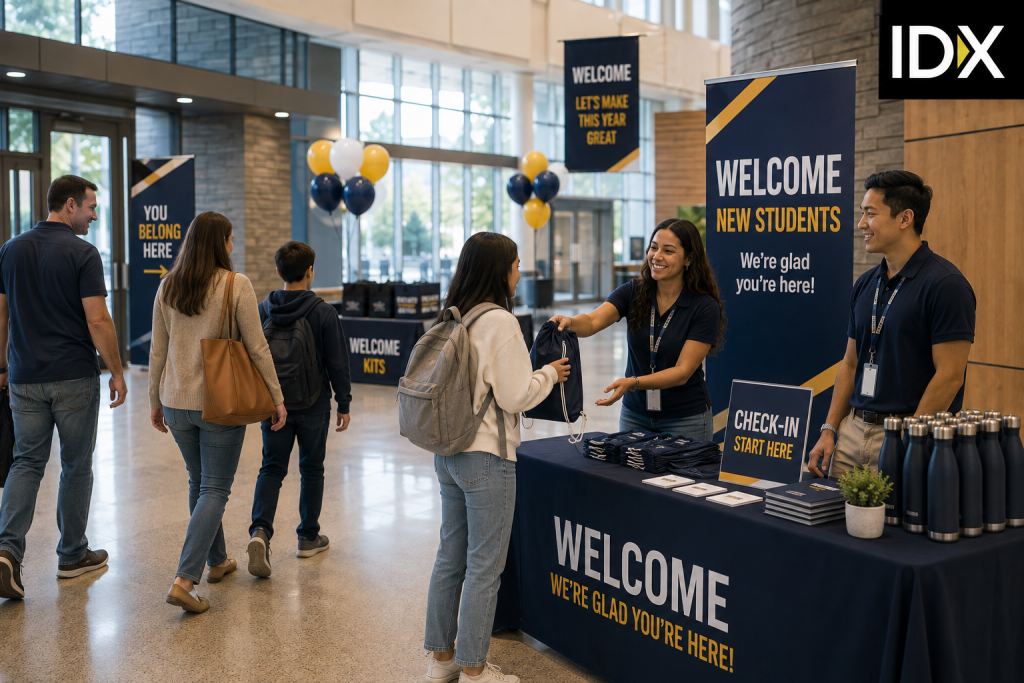
This is exactly the kind of first-impression strategy IDX helps schools and districts build: from brand awareness programs that create a consistent, welcoming identity across every campus touchpoint to custom kitting and welcome boxes that turn an orientation table into a moment a student remembers. If you want to see how other organizations have approached first-impression and engagement challenges like this one, our case studies walk through real programs from start to finish.
The Payoff: What Getting This Right Is Worth
None of this is about spending more, it’s about spending on the right fifteen minutes. A school that invests in a well-planned first impression is investing directly in the outcomes that matter most to administrators and families alike: better attendance, since safety and positive school conditions are strongly linked to lower chronic absence; stronger year-long engagement, since connected students post higher grades, test scores, and graduation rates; and calmer, more confident families, who walk away from day one trusting that this school had a plan for their child before they even said their name.
Those outcomes compound. A family that feels welcomed on day one is a family more likely to re-enroll, to volunteer, and to advocate for your school in the community: the kind of quiet, long-term loyalty that no single event can manufacture, but that a great first fifteen minutes can absolutely set in motion.
Ready to make your first fifteen minutes unforgettable?
Let’s talk about a welcome experience, from orientation kits to campus-wide spirit gear, that gives every student and family a reason to feel like they already belong.