Kitting services have evolved far beyond simple packaging and assembly. Today, organizations rely on scalable kitting programs to support employee onboarding, sales enablement, event distribution, customer engagement, and branded merchandise fulfillment across distributed teams and markets.
What was once considered a basic operational task has become part of a larger operational and brand experience strategy. Organizations increasingly view kitting services not simply as fulfillment, but as infrastructure that supports consistency, scalability, and execution across departments.
Kitting Today Supports Far More Than Boxes
Modern kitting supports nearly every part of the organization, including:
- New hire and remote onboarding
- Sales and channel enablement
- Events and roadshows
- Product launches
- Partner and customer engagement programs
- Franchise and multi-location brand rollouts
Each use case carries expectations around speed, consistency, visibility, and accuracy that go far beyond packing materials into cartons.
Organizations are no longer evaluating kitting solely on whether materials arrive. They are evaluating whether the experience aligns with the brand, whether programs scale efficiently, and whether internal teams can execute without operational strain.
Why Kitting Has Become More Complex
The rise of remote work, distributed teams, acquisition activity, faster campaign cycles, and national event strategies has fundamentally changed fulfillment expectations.
Organizations now need kitting systems capable of supporting:
- rapid deployment
- centralized inventory visibility
- scalable fulfillment
- consistent brand presentation
- repeatable operational workflows
What may have once been manageable internally often becomes difficult to sustain as programs expand across regions, departments, and timelines.
A growing organization may simultaneously manage employee onboarding kits, trade show kits, sales enablement packages, customer appreciation campaigns, and partner launch materials across multiple markets. Without centralized workflows and visibility, complexity compounds quickly.
Kitting Is Now Part of the Experience Layer
Modern kitting sits at the intersection of logistics and brand experience.
Every detail sends a message:
- Is the kit complete or missing components?
- Does it arrive early, late, or exactly when expected?
- Is the presentation intentional or improvised?
- Does it feel cohesive or pieced together?
- Does the quality of the presentation and product assortment align with the brand?
These factors quietly shape perception. A polished, well-executed kit communicates preparedness and professionalism. A rushed or inconsistent one introduces friction before the program even starts.
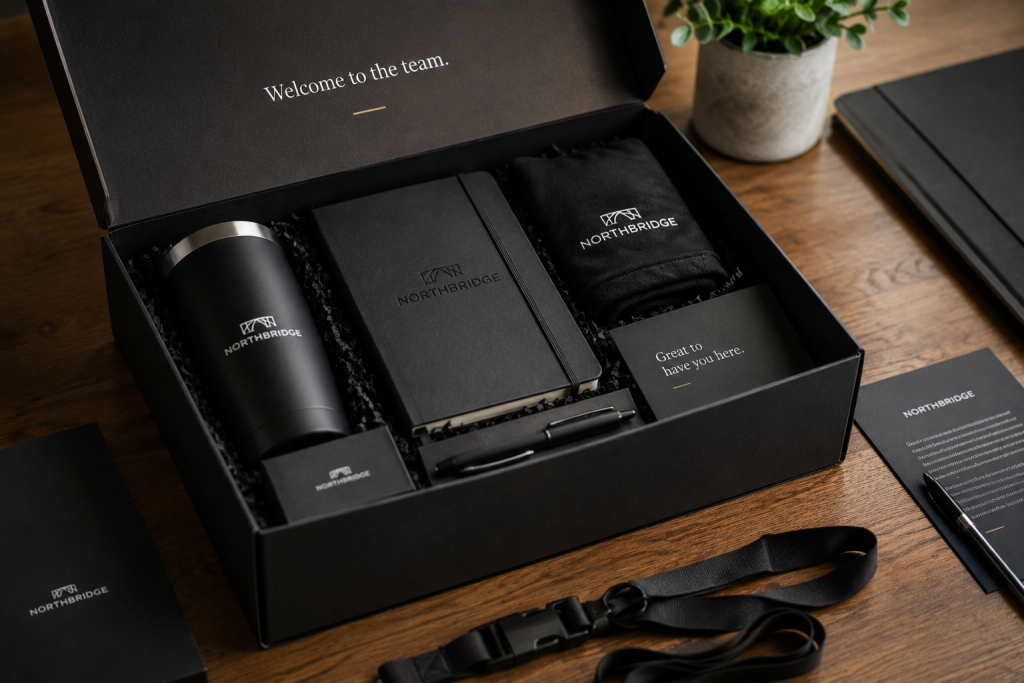
professionalism, and brand consistency from the very first interaction.
This becomes especially important in employee onboarding programs, where the first interaction often shapes how employees perceive the organization’s culture and operational maturity. The onboarding experience itself has increasingly become part of employer branding and employee retention strategy, particularly for organizations supporting remote teams, acquisitions, or distributed workforces.
Organizations looking deeper into how onboarding impacts employee experience can also explore our article on employee onboarding kits and why the first interaction with a company often shapes long-term perception.
Why Kitting Gets Difficult to Manage Internally
At smaller volumes, internal kitting can feel manageable. But as programs grow, operational cracks often appear quickly:
- Inventory lives across offices, storage rooms, and spreadsheets
- Assembly becomes reactive rather than repeatable
- Errors increase under tight deadlines
- Teams lose visibility into stock levels and replenishment needs
- Shipping coordination becomes increasingly fragmented
- Last-minute event preparation creates internal fire drills
Most offices were never designed to operate as fulfillment centers, and scaling manual processes rarely ends well during peak demand periods.
Many organizations discover that what initially felt cost-effective internally eventually creates hidden operational costs through delays, inefficiencies, duplicated labor, inconsistent presentation, and preventable shipping mistakes.
Common Kitting Challenges Organizations Face
As programs grow, organizations often encounter the same operational bottlenecks:
- inconsistent kit presentation across regions
- manual assembly errors
- inventory shortages
- duplicate shipping costs
- disconnected vendor coordination
- lack of SKU visibility
- delayed event shipments
- difficulty forecasting replenishment needs
These issues are rarely caused by poor intent. More often, they stem from systems that were never designed to scale.
The challenge is not simply assembling kits. The challenge is maintaining consistency and operational visibility while managing changing timelines, fluctuating inventory, and growing program complexity.

workflows, quality control checkpoints, and centralized coordination.
Kitting as an Operational System
Today, effective kitting functions more like operational infrastructure than a packaging task.
Scalable kitting services often require:
- centralized inventory management and SKU control
- documented assembly workflows
- quality control and verification checkpoints
- address validation and shipping logic
- real-time inventory visibility
- the ability to scale from hundreds to thousands of kits without disruption

SKU visibility, and documented operational workflows.
When these systems are in place, kitting becomes predictable, repeatable, and efficient regardless of volume surges or campaign complexity.
This operational structure allows marketing, HR, sales, and events teams to move faster without constantly rebuilding fulfillment processes for every initiative.
The Hidden Value of Centralized Kitting
Organizations often discover secondary benefits once kitting becomes modular and centralized:
- faster turnaround for last-minute events or campaigns
- consistent brand presentation across teams and regions
- reduced shipping costs through consolidation
- improved forecasting and inventory planning
- fewer operational bottlenecks during launches
- reduced pressure on internal marketing, HR, and events teams
These gains are not just logistical. They improve confidence across departments responsible for delivering consistent brand experiences.
This becomes particularly valuable for organizations managing employee onboarding kits, remote onboarding programs, recurring event fulfillment, or sales enablement initiatives where consistency and delivery timing directly impact the employee or customer experience.
When teams know inventory is centralized, workflows are documented, and fulfillment is scalable, planning becomes significantly more proactive and less reactive.
When Companies Benefit Most From Scalable Kitting
Centralized kitting services are especially valuable for organizations that:
- run multiple events annually
- support remote or distributed workforces
- manage growing partner or territory networks
- frequently update kit contents
- experience seasonal or campaign-driven spikes
- operate across multiple locations or franchise systems
At that point, the conversation often shifts from:
“Can we assemble kits internally?” to “What does inconsistent scale actually cost us?”
Frequently Asked Questions About Kitting Services
What are kitting services?
Kitting services involve assembling, packaging, storing, and distributing multiple products or materials into organized kits for onboarding, events, sales enablement, customer engagement, and fulfillment programs.
Why are kitting services important for growing organizations?
As organizations scale, kitting services help create operational consistency, centralized inventory visibility, faster fulfillment, and a more reliable brand experience across teams and locations.
What types of programs use kitting services?
Common use cases include employee onboarding kits, event kits, trade show fulfillment, sales enablement programs, franchise rollouts, customer appreciation campaigns, and branded merchandise distribution.
How do centralized kitting programs improve efficiency?
Centralized kitting programs reduce duplicated inventory, improve forecasting, streamline shipping workflows, and help organizations scale fulfillment operations more efficiently.
Why do companies outsource kitting services?
Many organizations outsource kitting services to improve operational scalability, reduce internal strain, maintain quality control, and create a more consistent experience across programs and locations.
Reframing the Conversation
The question organizations face is no longer whether they can assemble kits internally.
It is whether their current approach consistently delivers the experience they designed without creating operational bottlenecks, internal strain, or last-minute compromises.
As organizations scale, kitting becomes less about packaging and more about operational consistency, fulfillment infrastructure, and brand execution.
When kitting is treated as infrastructure rather than an afterthought, programs move faster, teams operate with less friction, and the experience lands the way it was intended to.