Stop Gifting. Start Solving.
Trade show merchandise that drives retention has one thing in common: it shows up at exactly the right moment, for exactly the right problem. Not a hypothetical future problem. Not a lifestyle aspiration. Instead, it addresses a real, present, felt inconvenience; the kind that quietly degrades the event experience for every attendee who encounters it.
Consider the dead phone at 2 PM on day two. Or the aggressively air-conditioned general session. Or the carry-on that won’t close because of three days of accumulated swag. Or the 10,000-step afternoon with nothing to drink but $7 bottled water from the convention center.
These are not abstract needs. They are predictable, universal, and entirely solvable. As a result, the brands that solve them with something practical, well-made, and tastefully branded earn a depth of goodwill and a longevity of brand impression that no tote bag or lanyard could ever generate.
At IDX, we work with marketing teams to design event experiences where every touchpoint, including merchandise, is intentional. The shift from “branded gift” thinking to “problem solved” thinking is one of the highest-leverage changes a field marketing team can make. This article explains why, and how to do it.
Why Utility Is the Only Reliable Path to Retention
The behavioral science here is straightforward. According to research published in the Journal of Consumer Psychology, people assign significantly higher value to objects that reduce friction in their current environment than to objects that simply appeal aesthetically or carry status signals. At events, where friction is constant and energy is finite, this effect is amplified.
For example, a 2023 study from the Advertising Specialty Institute (ASI) found that utility is the number one driver of promotional product retention, cited by 76% of respondents as the reason they kept a branded item. Notably, this held across all demographics. Younger attendees valued utility just as highly as older ones, despite common assumptions that Gen Z prioritizes aesthetics or sustainability signals over function.
The implication, therefore, is direct: if your merchandise doesn’t solve something, it’s competing on aesthetics alone, and aesthetics is a losing game when you’re one of 200 exhibitors in the same hall.

The Four Friction Points Every Event Creates
The most effective trade show merchandise strategies start not with a product catalog but with an empathy audit: a structured look at what your target attendees actually experience before, during, and after the event. Four friction points emerge consistently across virtually every trade show, conference, and field activation format.
1. Power: The Dead Phone Problem
Conference venues are architecturally hostile to battery life. Outlets are scarce, and sessions run long. Consequently, the attendee who arrived at 8 AM with a full charge is running on 12% by the time your most important afternoon conversation needs to happen.
A quality portable power bank, not the cheap 2,000 mAh variety that barely charges a phone halfway, but a 10,000 mAh unit that meaningfully extends a day, solves an urgent, felt problem. Every time the attendee plugs in, they’re interacting with your brand at a moment of relief, not obligation.
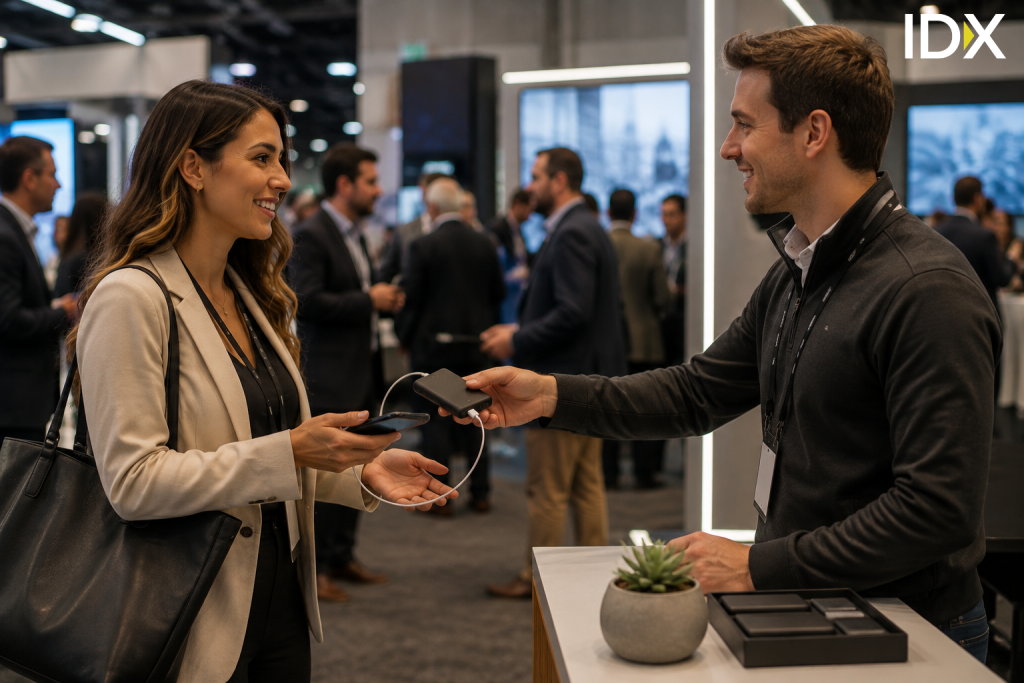
Retention signal: Power banks are used an average of once per week, generating an estimated 1,000+ impressions over their lifespan according to ASI data. That’s a cost-per-impression that competes favorably with digital advertising.
2. Comfort: The Cold Venue Problem
Convention centers are notoriously over-air-conditioned. It’s not an accident: high foot traffic generates body heat, and facilities managers overcorrect. The result is that a meaningful percentage of your attendees spend general sessions and breakout conversations physically uncomfortable.
A quality quarter-zip or branded fleece vest doesn’t just solve a thermal problem; it also solves a visibility problem for your brand. Apparel worn at an event becomes a walking signal to everyone else in the room. When that apparel is well-designed, meaning it doesn’t read as a corporate billboard, people wear it willingly, publicly, and repeatedly.
The design caveat is critical: apparel with a subtle, tasteful logo on the chest or sleeve gets worn, while apparel with a large logo across the back gets left at the hotel. The difference in cost is negligible; the difference in impressions is substantial.
Retention signal: ASI data shows that outerwear averages 3.3 years of use, the highest retention rate of any merchandise category.
3. Travel: The Overpacked Bag Problem
Multi-day conferences create a specific logistical problem: attendees arrive with a carefully packed bag and leave with considerably more. Accumulated merchandise, printed materials, product samples, and gifts from multiple exhibitors have to go somewhere, and “somewhere” is usually a straining carry-on or an overloaded tote.
A well-made packing cube, a compression bag, or a high-quality drawstring bag designed specifically for overflow solves a real organizational problem at exactly the right moment. Better still, these products travel home with the attendee and integrate into their packing routine for every subsequent trip.

Meanwhile, most exhibitors are creating the packing problem (yet another tote bag). A brand that solves it, by contrast, occupies a distinct and memorable position in the attendee’s mind.
Retention signal: Travel accessories have above-average retention rates and are used across multiple contexts, including business travel, weekend trips, and gym bags, multiplying impression opportunities.
4. Hydration: The Premium Bottle Problem
Convention center hydration is inconvenient by design. Water stations are sparse, bottled water is expensive, and carrying a bottle from registration is an afterthought for most attendees. By mid-afternoon, a significant portion of your audience is mildly dehydrated, which directly affects cognitive performance, mood, and engagement.
A premium insulated bottle, not a cheap plastic vessel but a quality stainless steel option that keeps water cold for 12+ hours, solves an ongoing need. It also has one of the highest daily use rates of any merchandise category, generating brand impressions at home, at the gym, and at the office long after the event.
In addition, premium reusable bottles carry an implicit environmental signal that resonates with younger marketing audiences, and this is not a trivial secondary benefit. In fact, a 2023 PPAI survey found that 68% of Millennial and Gen Z event attendees said they were more likely to keep a product perceived as environmentally conscious.
The Problem-Solution Merchandise Matrix
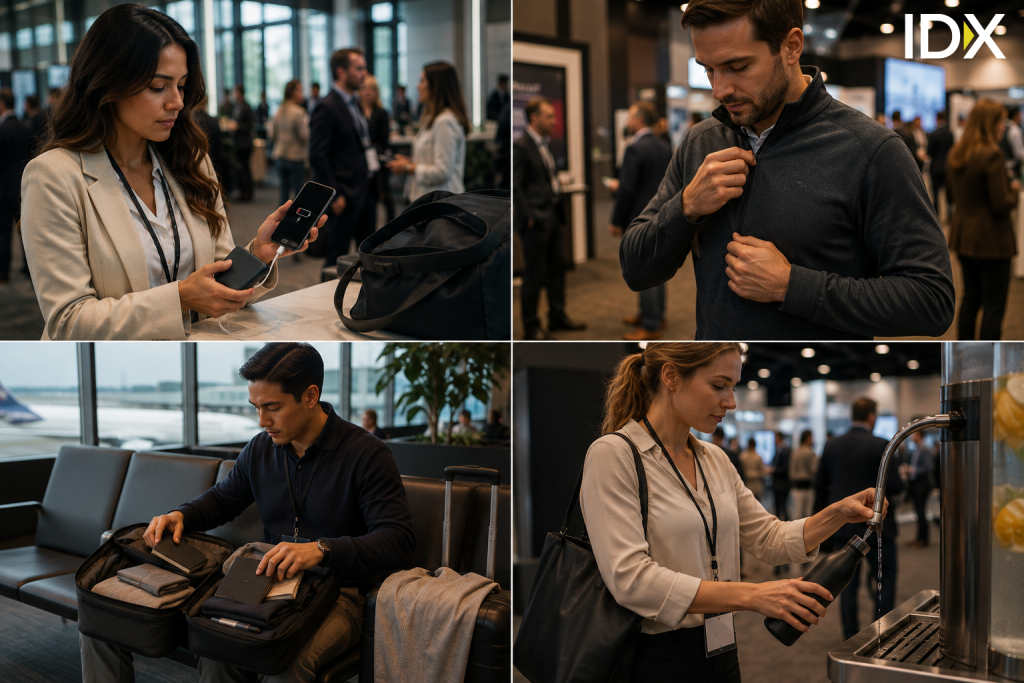
Use this framework to map attendee friction points to merchandise opportunities at your next event:
| Attendee Friction Point | Timing | Merchandise Solution | Retention Potential |
|---|---|---|---|
| Dead phone / low battery | Day 1 afternoon onward | 10,000 mAh power bank | Very High — weekly use |
| Cold sessions / venue | All day | Quarter-zip, vest, or fleece | Very High — 3+ year lifespan |
| Too much stuff to carry home | Day 2–3 | Packing cube, compression bag | High — integrates into travel routine |
| Dehydration / expensive water | All day | Premium insulated bottle | Very High — daily use |
| Eye strain / long screen exposure | Day 2–3 | Blue light glasses | Medium-High — office daily use |
| Sore feet / long walking days | Day 1–2 | Insole inserts, blister patches | High — memorable moment of relief |
| No surface to write on | Session breaks | Slim hardcover notebook | Medium — depends on quality |
| Tangled cables / no organization | Post-event | Cable organizer, tech pouch | High — persistent daily utility |
The last column matters as much as the first. A product that solves an acute problem brilliantly but has no post-event utility still limits your impression lifespan. Ultimately, the ideal merchandise solves a problem at the event and then earns a place in the attendee’s everyday life afterward.

Tiering Your Merchandise Strategy
Not every attendee interaction has equal strategic value. A prospect who has never engaged with your brand warrants different merchandise than a customer at their third renewal, or a champion who generates referrals. For this reason, merchandise tiering is one of the most underutilized tools in event marketing.
Tier 1 — Awareness (broad distribution): Lower unit cost, but still utility-first. A cable organizer, quality pen set, or snack pack doesn’t solve a major problem but communicates care and intentionality. Unit cost: $5–10.
Tier 2 — Engagement (qualified prospects, active conversations): Mid-range utility products that solve a clear event friction point, such as a premium water bottle, packing cube, or Bluetooth tracker. Unit cost: $15–35.
Tier 3 — Relationship (priority customers, key prospects, VIPs): High-quality, long-lifespan items, a quarter-zip or vest, leather notebook set, or premium power bank kit. Unit cost: $50–100+. These are not giveaways; they are relationship investments.
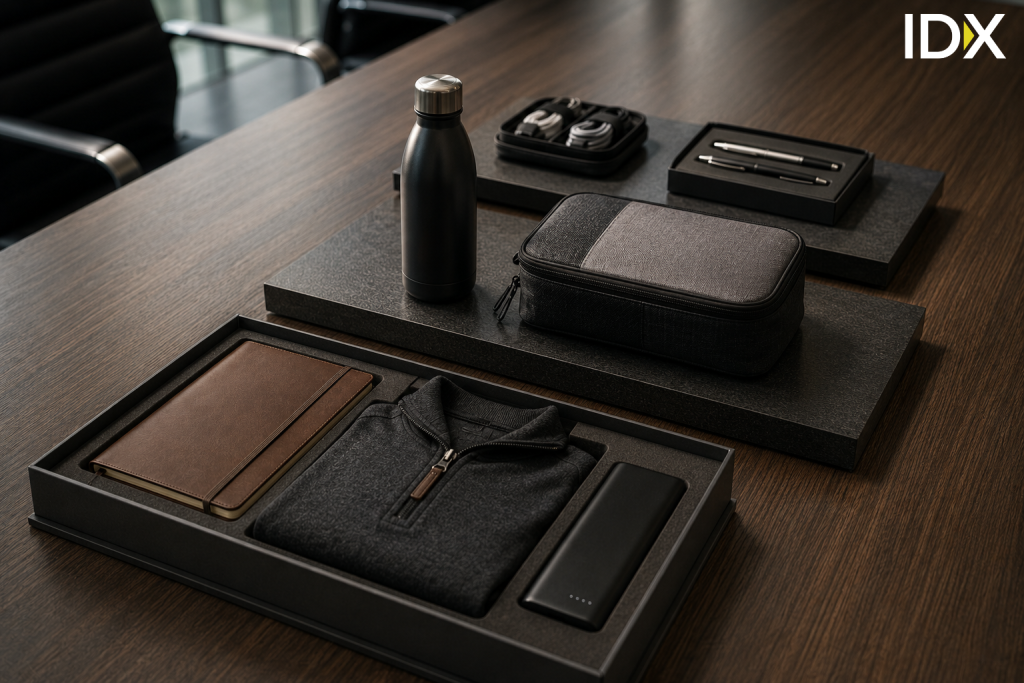
This tiered approach also solves a common budget problem. You don’t need to give every attendee a $75 fleece. You need to give the right attendees the right item at the right moment. That precision, a core competency of IDX’s event strategy and activation services, is what separates high-performing event programs from ones that simply spend money.
Designing for the Moment, Not the Shelf
There’s a critical execution element that most merchandise strategies miss: timing and context of distribution.
A power bank handed to an attendee during registration, before they feel the pain of a dying phone, lands differently than one offered by a booth staffer who notices an attendee frantically scanning for an outlet. The second scenario creates a moment of genuine service and demonstrates an attentiveness that reflects directly on the brand.
In other words, this is experience design applied to merchandise. Although the product is identical in both scenarios, the impression it leaves is entirely different.
IDX helps event teams design these moments deliberately by training booth staff to read attendee signals, positioning merchandise distribution at friction points rather than at registration tables, and integrating product giveaways into demonstrations and conversations rather than treating them as a separate “swag” function. [Learn how IDX uses the Experience Loop Framework to design memorable event experiences.]
Pre-Event Merchandise Planning Checklist
Before finalizing merchandise for your next activation, run through this checklist:
- Have I mapped the primary friction points attendees will experience at this specific event?
- Does each merchandise item solve at least one of those friction points?
- Is the quality level consistent with what I’d use myself?
- Is the branding restrained enough that recipients won’t feel like a walking advertisement?
- Have I thought about when and how each item will be distributed, not just what it is?
- Have I tiered merchandise investment to match attendee relationship value?
- Does the item have clear utility beyond the event itself?
- Have I calculated cost-per-impression over a realistic use lifespan, not just unit cost?
FAQ: Trade Show Merchandise Strategy and Utility
What type of merchandise performs best at trade shows?
The highest-performing trade show merchandise solves a real problem the attendee is experiencing during or immediately after the event. Power banks, premium insulated bottles, quality outerwear, and travel accessories consistently achieve the highest retention rates because they integrate into daily routines. According to ASI research, utility is cited as the top retention driver by 76% of promotional product recipients.
How do I choose trade show merchandise that won’t get thrown away?
Start with an empathy audit: map the actual friction points your attendees experience at this type of event. Then select merchandise that directly addresses one or more of those points. Avoid commodity items that feel generic (standard tote bags, cheap pens, stress balls) in favor of products with clear post-event utility and quality that reflects well on your brand.
What’s the ROI on premium event merchandise versus cheap giveaways?
Premium merchandise consistently outperforms cheap giveaways on cost-per-impression. For instance, a $50 quarter-zip worn regularly for three years generates thousands of brand impressions, while a $5 tote bag discarded within a month generates essentially none. The ROI calculation should always be based on impression lifespan, not unit cost.
Should all event attendees receive the same merchandise?
No. A tiered merchandise strategy, aligning product quality and value to attendee relationship stage, is more effective and more budget-efficient. High-value prospects and existing customers warrant meaningfully better merchandise than first-time visitors, and this tiering also creates a signal of intentionality that flat distribution does not.
How does merchandise fit into a broader event experience strategy?
Merchandise is most effective when it’s designed as an integrated touchpoint within the event experience, not a standalone giveaway function. The moment of distribution, the context in which it’s given, and the problem it visibly solves all shape the brand impression. Experience-led merchandise strategy, as practiced by IDX, treats every product decision through the lens of the attendee journey.
What makes IDX different from a standard promotional products vendor?
IDX approaches merchandise through event psychology and experience design, starting with attendee behavior, friction mapping, and brand impression goals, then working backward to product selection and distribution strategy. As a result, the merchandise earns retention because it was designed for the recipient, not for logo visibility.
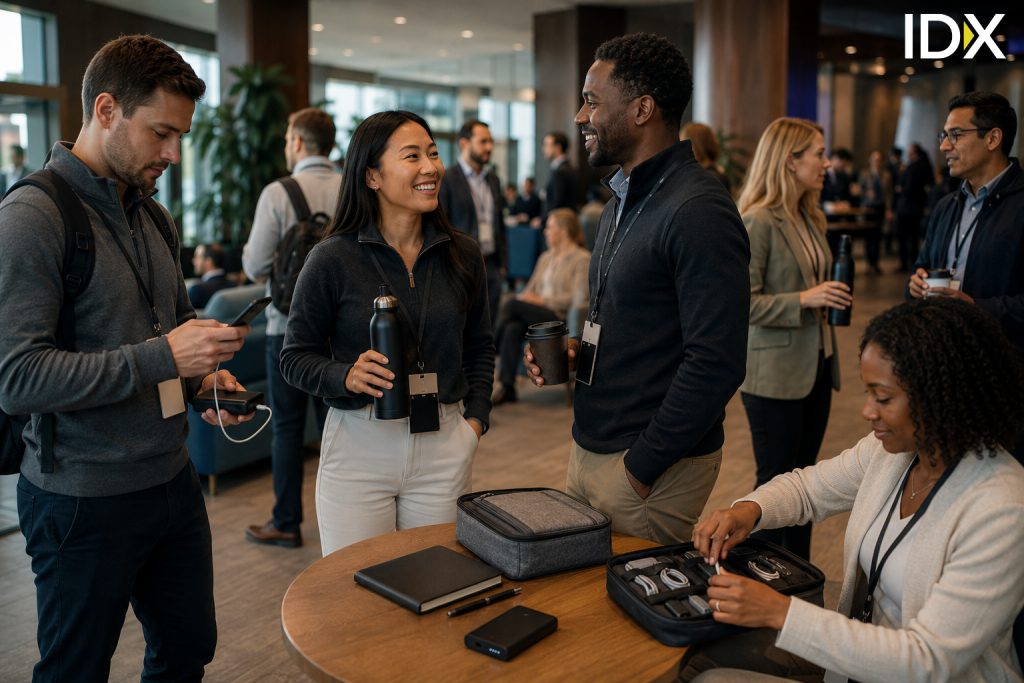
The Underlying Principle: Convenience Over Clutter
The best trade show merchandise doesn’t add to the pile. Instead, it reduces it by solving a problem so effectively that the attendee would have bought this product themselves if they’d thought of it.
That is a high bar. It requires understanding your attendee more deeply than most event teams invest in doing, and it requires resisting the gravitational pull of “everyone does tote bags” in favor of a deliberate, defensible choice about where your merchandise budget creates the most value.
It also requires treating merchandise not as a procurement decision but as an experience design decision. After all, the product is a touchpoint, that touchpoint creates an impression, and the impression either builds the relationship or erodes it.
At IDX, we help marketing teams build event programs where every element, from booth design to merchandise to post-event follow-up, is calibrated to the attendee experience. Because in event marketing, convenience isn’t a nice-to-have. It’s the strategy.
IDX designs event experiences, activations, and infrastructure for marketing teams that measure success in brand relationships, not just brand impressions. [Explore IDX event strategy and merchandise solutions →]